
In this next section I want to talk about to really
important figures, the artist Giotto and the author Dante. These two historical
figures have a direct impact on the creation of the decoration of the Chapel in
Padua called the Arena Chapel. In order to understand these two historic
figures’ works have to look at the social and economic world of the
Renaissance.

Giotto is a Proto Renaissance painter. This means
that Giotto is working in a transitional period between the Gothic and the
Renaissance periods. His work exhibits qualities of the late Gothic and also
some innovative new things that were happening during the Renaissance. The main
patron for this family was the Scrovegni family.
EnricoScrovegni was the grandson of amending Reginaldo. He hired Giotto to paint the interior of this Chapel as an indulgence meeting that what he was hoping was the church and God would forgive his grandfather Reginaldo for being what was called the userer. This is a common practice during the Renaissance what would happen is a person would go to the church and ask the church if there was something that they could do in order to indulge the church and get forgiveness for sins. One way in which the church so-called forgave sins was to was to ask a patron, the patron is a person who pays for work of art, to decorate a church by hiring a top artist. What this person was hoping was that by indulging the church they could buy their ancestor out of years of purgatory or hell.


It’s kind of a contradiction in terms to see Reginaldo Scrovegni depicted on the walls of the arena Chapel in Padua but it also relates to the author Dante whose handwriting is all over the arena Chapel in a reference to his epic poem the Divine Comedy.
Dante was a famous Florentine who was exiled from Florence for siding with a wrong or less powerful political party during the 13 century. While in exile and living in Padua Italy he began his work on an epic poem that was written in vernacular Italian. The poem that within imaginary epic journey that Dante took during the middle of his years into the several rounds of hell heaven and purgatory. It starts with the journey down into the underworld in which he’s ushered down by a a series of large monstrous animals. When he gets to the first level of purgatory he is met by the classical poet Virgil. The reason why Virgil meets him and is not in heaven is because Virgil never knew Christian teachings but somehow you still worthy of traveling between the realms.

Dante’s version of the afterworld is based more or less on a series of gases and miss apprehensions about what the Bible says and it is also combined with the classical view of the world. Probably one of the most important things about it is that sort of popular culture view of the afterlife that’s also based on classical teachings doesn’t really exist in the Bible. The fact that it’s written in Italian also made it much more accessible to the population at that point in time and serve to elevate Dante as one of the first and foremost writers of the Renaissance.
The fact that it was written in Italian meant that
artists and intellectuals were able to read his version and they sort of
combined it with images from medieval last judgment and developed a further
iconography during the Renaissance of the betrayal of the afterlife which
Giotto the artist picked up on. He people this afterworld with a series of
characters and people that he knew from Florence. In some cases it was an
indictment of some of his enemies but it was also an indictment of some of his
friends because he put both his friends and enemies both in hell and in heaven.
In his first meeting in purgatory Dante meets to characters from Florence and Paolo and Francesca. The theme of Paolo and Francesca is a theme that shared in many works of art and you also see it in the Gates of hell by the sculptor Rodin. The story goes something like this when Dante sees Paolo and Francesca floating in the sky of purgatory he calls to them and asks them what’s wrong. Francesca floats down to him and explains to him that she committed the sin, but you get the feeling from her description that she doesn’t really believe it’s a sin. Person wasn’t sitting around one afternoon reading Boccaccio’s book the Decameron . She’s described as reading this cam run for pleasure with her brother-in-law. She literally says something like she was reading it for pleasure and you get the feeling that she was actually reading it for the dirty parts. This inflamed Francesca and Paolo and just before they were about to kiss her husband came in and murdered both his brother and her. The result they ended up in purgatory.

Purgatory for Francesca and Paolo means that they are floating around in the sky out-of-control but they cannot touch each other nor can they really see each other. They basically float around in the sky with their backs to each other three or 4 feet away from each other almost within arms length. If they try to get away from each other they are forced to stay that single 4 feet away from each other but if they try to touch each other they also cannot touch each other. In essence they got what they desired their out of control and in this state of not being able to get to one another. One gets the feeling that if they admitted their sin they might graduate out of purgatory and maybe make it to heaven and that’s the whole point. Dante’s kind of giving you a view of what sin really is.
In addition to putting Francesca and Paolo and hell Dante also places various clergy members in hell with their heads and holes also in purgatory. He’s kind of giving you examples that even the clergy can go to heaven and even the clergy can go to hell that everyone is not always on the right path. The ideas that Dante’s kind of giving you a feeling of what his life is like at this sort of existential turn point in the middle of his life. In essence what he’s trying to do is find the right path and show you through literature how to attain the kingdom of heaven.
Another set of characters that Dante puts in purgatory or hell are the actual Scrovegni family. It’s interesting because Giotto also includes Reginaldo Scrovegni in his fresco the Last Judgment. In EnricoScrovegni is standing just left of the crucifix holding up an image of the Arena Chapel itself. In fact this somehow relates to the fact that Dante puts Reginaldo Scrovegni in the seventh circle of hell which is a place where the evil and violent go to. So in essence what EnricoScrovegni and John torture to do is renovate Reginaldo’s reputation that was established I Dante in the Divine Comedy.


This somewhat relates to one of the smaller frescoes
in the Chapel which is an allegorical figure of avarice and charity. These
images of virtues and vices contain emblems and icons that are very similar to
some of the ones that are in Dante’s script here’s a passage,
Despondency was bursting from their eyes this side them that their hands kept fending off, at times the flames, at times the burning soil not otherwise do dogs in summer now with muzzle now with paw when they are bitten by fleas or gnats or by sharp gadfly. When I set my eyes upon the faces of some who the painful fire falls, I recognized no one but I did notice that from the neck of each purse was hung that had a special color or an emblem and their eyes seemed to feast upon these pouches.
What he’s describing is actually the purses and the
color of the purses which is emblematic of the Scrovegni family.


If you look at the Arena Chapel, you’ll see that it’s arranged almost like a comic strip but the comic strip has more meaning than that. It’s arranged in a way that you can actually understand that there’s a hierarchy in place as well. It’s meant to describe the actions of the ideal person who was Jesus but it’s also meant to describe the actions of on ideal people and how and where they are in the world.


For example there’s a series of frescoes that are painted in Brown’s this is also referred to as monochromatic or in “grisailles” French for in gray. These monochromatic frescoes are also painted as if they look like marble. They look like a series of marble sculptures and each one represents the virtues and vices if you look closely at them you’ll see that they almost stand as columns or supporters for the frescoes that are above them. The frescoes that sit atop the virtues and vices represent the life and times of Jesus Christ. These monochromatic paintings are sort of faux finish they are in essence trompe “l’oeil” which means in French to fool the eye. In some ways illusionistic painting like this is a way of getting out of using real materials like marble but it also shows the artists virtuosity in depicting textures and light. In essence this kind of painting shows the artists abilities.
Let’s start with the Last Judgment. The theme of the
Last Judgment, is one that has been used for thousands of years in Christian
art. There’s even one that’s kind of a last judgment in Egyptian art and even
has scales and it like some of the ones that we’ve been looking. The basic
design of it is structured in such a way that it symmetrical. First one needs
to look at the organization of the fresco in order to understand how these
things work.

Like it’s Romanesque predecessor Giotto’s Last Judgment is designed to be symmetrical you can divided town the center it also has three layers to it at the bottom are the elect or people being pulled out of their graves for the last judgment that is on the right-hand side of Jesus but also on our left-hand side. We can also see this in the Romanesque version however the people being lifted out of their graves are all on the bottom level of the Romanesque sculpture. We see in the center of each work of art the figure of Jesus larger than all of the other figures this is called hieratic scale. Everyone on the right-hand side of Jesus seems to be being saved or entering the Kingdom of Heaven. Everyone on the left-hand side of Jesus is in a bit of trouble and if you look at the bottom level to the left of Jesus you’ll see that that represents hell. The top layer represents heaven with the disciples and the apostles surrounding Jesus advising him and also trying to intercede on our behalf. This means that their actually talking to Jesus on our behalf and asking him to let us into heaven that’s why Catholics often pray to Saints because the same might have more influence with Jesus than our own prayers.


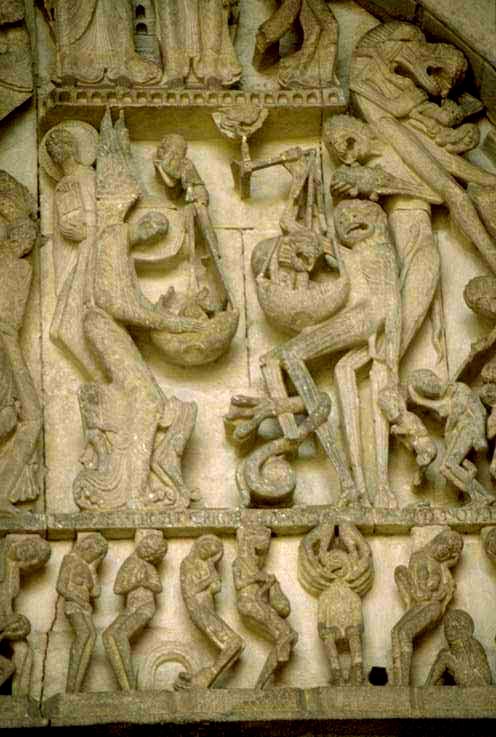

The overall structure of scenes of Last Judgment all adhere to this basic schema. In Giotto’s version however he adds some extra things that are probably based on Dante. For example, in hell there’s a River fire and the devil is represented much how Dante describes him in the Divine Comedy. One of the things that seems to be influenced most by Dante but it also exists in earlier frescoes is that there’s a figure who looks like he might be clergy member in hell seemingly blessing a figure whose offering him a bag of money. This in some ways could also represent Reginaldo Scrovegni and could be a sarcastic statement that indulgence is not working and that the fresco will not really get him out of hell.


Focusing in on Satan he is riding on the backs of
dragons he’s eating people and then excreting them out and that is they are
hell this is what they suffer from. This very much matches some of Dante’s
descriptions as well. There’s even a River of fire. It also recalls classical
descriptions of Hades or the afterworld. We’ll see similar kinds of images in
the work of Michelangelo.

Looking at the cycle of frescoes as a whole series of stories you can dissected in a sort of narrative cycle or a structural analysis. In some ways it’s very similar to how we read comic books. In this case some foundational kinds of images are placed at the very bottoms in this case the virtues and vices, but we also see wedge between the virtues and vices and at the top level the life and times of Mary and her parents are the life and times of Jesus. It’s almost like the story or bands the two bands that describe the life and times of Jesus are the cream inside and Oreo cookie the most important ideas. The virtues and the vices are the foundation on which Jesus is ideas are built and the Catholic faith, Jesus is in the center of everything, including the Last Judgment, and Jesus his parents and family are above him and it seems as if there wisdom is sort of trickling down to him as a on the entire story. Study the diagram and notice how things are arranged in such a way that the story concerning Jesus is at eyelevel and the most visible thing and Jesus is the most visible figure In the Last Judgment. He is the largest figure in the faith.

We also need to take a look the frescoes in terms of their formal qualities. This means how they physically look and how illusionistic they are. We’ve already discussed the trompe l’oeil aspects of the virtues and vices they look a little bit like sculpture from for instance the Panathenaic procession from ancient Greece. But their other things that make the frescoes very illusionistic.
Especially in the Last Judgment we get a sense of foreshortening, which is a way of shortening the figures as the project out of the picture plane and also we get more realistic anatomy. Giotto is also giving you a sense of light and shadow which is referred to as chiaroscuro in his painting. Even with some of the more architectural things like the chairs that the apostles are sitting on seem to almost have a sense of perspective although in this case it’s intuitive perspective not linear perspective. In essence job to is doing something different than his teacher Cimabue. He’s using accurate anatomy he’s using a little bit of intuitive perspective and he’s also using shading also refer to as chiaroscuro which defines even the drapery on the bodies.
Focusing in on one of the frescoes that depicts
Jesus entering the city of Jerusalem you’ll see that the iconography is pretty
standard and also resembles very much this Bible passage.
Matthew chapter
21.
When they drew near
Jerusalem and came to Bethphage on the mount of olives, Jesus sent two
disciples, saying to them, go into the village opposite you, and immediately
you will find an ass tethered, and a colt with her. Untie them and bring them here to me. And if anyone should say anything to you,
reply the master has need of them that he will send them at once. This happened so that you been spoken through
the prophet might be fulfilled say to say to daughter Zion, behold, your King
comes to you, meek and riding on an ass, and on a colt, the foal a beast of
burden the disciples went and did as Jesus had ordered them. They brought the ass and the colt and laid
their cloaks over them, and he sat upon them the very large crowd spread their cloaks
on the road, while others cut branches from the trees and strewed them on the
road. The crowds preceded him and those following kept crying out and saying was added to the son of David blessed is he who comes in the name of the Lord Hosanna in the highest and when he entered Jerusalem the whole city was shaken and asked who is this and the crowds replied. This is Jesus the prophet, from
Nazareth in Galilee.

The Bible passage as well as some stained-glass
windows and other depictions that we’ve looked at, all seem very much in line
with the iconography we see here. The boys are up in the trees cutting Palm
leaves and string them on the ground. There are people taking off their cloaks.
Throwing them all on the ground to protect or to honor the pathway of Jesus but
Giotto does something a little bit different. First of all there’s the formal
stuff such as shading and more realistic anatomy but he also seems to give a
sense of humanity to the figures. In the lower right-hand corner there’s one
figure they can’t seem to get his cloak off fast enough. The donkey which is
clearly described in the passage is smiling. Both of these things are kind of
jokes. The same way putting the clergy and hell is.

The architecture almost seems to be three-dimensional again it’s an intuitive perspective. Probably the most important thing though is a sense of humanistic gesture and how all of the figures relate to one another. The figures behind Jesus are overlapping and you can’t see each one of them this is almost how it really looks. Each of the figures is actually looking at Jesus and responding to him in a way that you and I might relate to the even have facial expressions.
Another panel that’s really important is the panel
showing the Lamentation or the Entombment of Jesus.

This is a very common theme in religious art entombment or lamentation kind of scene in which there figure surrounding the already dead Jesus and honoring him. In this instance Giotto does things that are a little bit different than some of the other painters though and it will be taken up by later Renaissance artist some of the things that he does.
In the sky floating above the dead Christ are series of Angels who all have facial expressions and seem to be expressing emotion. Their bodies are foreshortened they seem to be really swooping down and flying up and he really understands the volumes of their torsos.
The next level you can see the role of figures who are surrounding Jesus each have individual facial expressions their anatomy is accurate. One figure in attempt to show foreshortening even has his arms outstretched as he stands above Jesus in a pose that only seems to say “I can’t believe he’s dead.” Jesus is anatomy is almost heroic in a classical way he’s very well-muscled. In the foreground Giotto does something slightly different also. He puts to the figures with their backs to the viewer it’s almost like a detective movie from today. The backs of those figure seem to block your view and you want to look around them to be able to see him and to experience what they’re experiencing. It’s a way of pulling you into the painting.
Probably one of the most innovative things that
Giotto does in this painting is also to refer to the story of Mary Magdalene
washing Jesus’s feet and drying his feet with her hair but it wasn’t in this
episode that were looking at. If you recall that happens earlier in the life
and times of Jesus. In essence what Giotto is doing is identifying her figure
and separating her from the others by showing you that he understands some of
the things that happen in the Bible.


