Wednesday

Crybaby, 8x10 inches oil on canvas panel by Kenney Mencher


Crybaby, 8x10 inches oil on canvas panel by Kenney Mencher $375

I try to be as creative as I can with the titles of my paintings. I'm trying to suggest to my audience a trait or quality about the character that they see in the painting. In this instance I was trying to make a kind of painting that would appeal to a gay audience who were interested in twinks. In this case, this beautiful young man with his soulful eyes gazing off the edge of the canvas is designed to evoke an imaginative response from my viewers. I realized after I finished painting him that he looked a little bit like a crybaby to me. Hence the title.

According to the urban dictionary a twink is,

A "twink" is usually considered a homosexual male with attractive, boyish qualities. Typically from the ages of 18-25, and often thought as a young, white, fashionable male.

One of my favorite things to do is to paint small brushy portraits of faces. It's one of the things that I learned to do in high school, I went to the High School Art Design in New York City, where I studied painting with Max Ginsburg and Irwin Greenberg. Greenberg conducted an extra open studio time before school began that he called "The Old Hat Painting Club." We would get to school about two or three hours early and one of us would model for the rest of the students who would begin painting a wet into wet or "ala prima" painting of either the full figure, head and shoulders, or just the face of a single person. We would all dig into our pockets and contribute a quarter or $.50 to pay the model. This was way back in 1979 so that actually could amount to going out for sandwich or a meal.

Greenberg taught us a quick 19th-century style that is often referred to as wet into wet or sometimes ala prima. What this means is we with telling the canvas with some turpentine and a little bit of burnt sienna paint and then start drawing into this soupy mix with the darker brown, usually burnt umber, and draw with the brush. We would immediately start to model the shading or value structure as we painted and we would sometimes wipe out the lighter areas to be able to see the value structure or structure of light and shadow as it moved across the figure or face. You have to work very quickly and sometimes you only had two or three two-hour sessions to complete the painting and our teachers were so skillful that they were able to make a completed portrait, in the style of John Singer Sargent, sometimes in as little as an hour. It was a kind of magic and we strove to learn how to do that. Now at the ripe old age of 57 I'm able to paint beautiful young people and sometimes older handsome men in anywhere between 2 to 5 hours. In the style of my teachers. This painting took about, 6 to 7 hours, I'm not as good as Greenberg.

Here are some of the places on the web that are licensed or have permission to represent me.

https://www.kenney-mencher.net/
http://www.kenney-mencher.com/
http://www.etsy.com/shop/kmencher
https://www.instagram.com/kenneymencher/
https://www.facebook.com/Kenney.Mencher
http://www.youtube.com/user/kmencher

Tuesday

Bear and a Cuppa, 12x12 inches oil on canvas panel by Kenney Mencher


Bear and a Cuppa, 12x12 inches oil on canvas panel by Kenney Mencher 

$375

This original painting is one of the few rare paintings that I've made from my imagination. I usually need some sort of reference material such as a photograph or a live model to make my art and in this case I was attempting to make a painting based on a sort of shopping list of ideas that I had for both the subject matter and how it would look.

The subject, is one of my favorite homoerotic subjects to paint. A large bearish man wearing a T-shirt or a tank top. There's something so basic and so sexy about middle-aged men and especially bears. In this case he looks a little bit more like a muscle bear because his arms are so thick. I wanted the painting to have a high contrast of light and shadow, this is often referred to by an art buzzword called "chiaroscuro" and or with the spotlighting effect also referred to in Italian as "tenebrism."

I wanted the painting to be a more intimate and familiar kind of genre scene. The kind of scene of everyday life in which someone is drinking cup of coffee or large cup of tea and is caught up in the moment. That's why I've cropped in so close on the head and shoulders and in some ways the figure almost seems anonymous because he's not engaging with anyone else and the mug serves as a kind of mask or cover for his face.

Monday

After Care, 36x36 inches oil on stretched canvas by Kenney Mencher

After Care, 36x36 inches oil on stretched canvas by Kenney Mencher

After Care, 36x36 inches oil on stretched canvas by Kenney Mencher

The title of this painting, "Aftercare," is designed to be suggestive. Often in some sexual encounters, especially those that involve BDSM, there is a recovery time in which the dominant person takes care of war shows affection to the submissive partner. Although the theme in this painting is not necessarily one of sadomasochism, I was thinking that these two men had engaged in a sexual encounter. Part of the story in my head when I design the painting was that these are two gay men who have been cruising and had a nearly anonymous sexual encounter in which there was no time for them to engage in any of the niceties of "aftercare."

These multiple figure paintings have been pretty popular and I feel like it’s somehow my chance to grow and improve my art into a more conceptual way. Although most of my work is about the beauty of the male figure painted as skillfully as I can, the anatomy, shading and textural qualities of the paint, I feel like I’m growing in terms of the subject matter by including more narrative or story telling elements in my art. These new paintings are meant to be a bit of a “thematic apperception test” called by shrinks the TAT. When I was in college, I learned about a psychological technique developed by American psychologist Murray at Harvard University during the 1930s. The idea for the TAT emerged from a question asked by one of Murray's undergraduate students who reported that when her son was ill, he spent the day making up stories about images in magazines and she asked Murray if pictures could be employed in a clinical setting to explore the underlying dynamics of personality. I thought this would be a great point of departure for people looking at art.

I'm trying to take my subject matter a more meaningful place step beyond what I've been doing in terms of my art, where I usually paint a single beautiful or interesting looking man. In this case I was thinking of two more mature men, possibly married, in a relationship to one another. I'm attempting to tell more of a story by including multiple figures in a more complex composition. I've been working with the idea of juxtaposing a clothed figure against a nude figure and trying to tell more of a story and excite the viewers' imaginations. I wanted to go beyond the single nude or seminude figure which at times can be pretty predictable as a format in homoerotic art.

One of the things that I am proud of about the more formal elements in this painting are the color combinations, Rendering of the anatomy, clothes, and the paint texture. This painting took several days to complete and I had done several preliminary studies for it including a small 12 x 12" oil that has already been collected by a gallery owner in Palm Springs. I built on the original smaller studies by layering the paint and increasing the thickness and gestural paint handling in this painting.

You will not need to frame this painting unless you want to because the canvas wraps around the edges and the stretcher bars are about an inch and a half thick. Please see the photos.

The following are the only sites that are licensed or permitted to represent me or my work.

https://www.kenney-mencher.net/
http://www.kenney-mencher.com/
http://www.etsy.com/shop/kmencher
https://www.instagram.com/kenneymencher/
https://www.facebook.com/Kenney.Mencher
http://www.youtube.com/user/kmencher

Sunday


Did you know that the Leslie-Lohman Museum of Art’s collection includes over 25,000 works of art spanning more than three centuries? As we expand our holdings, we are committed to supporting living, working artists who represent a wide range of LGBTQIA+ experience. We’re very excited to share our most recent acquisitions, works by Jonathan Lyndon Chase and Lola Flash. Flash was a Leslie-Lohman Artist Fellow in our inaugural Fellowship cohort, 2017-2018. Jonathan Lyndon Chase is creating the award for this year's Leslie-Lohman gala honoree, Honey Dijon. Both artists are based in the United States, and their work reframes difference, confronts assumptions, and grapples with American hegemony through creating other worlds. These works will be on view in the Leslie-Lohman’s Living Room Gallery from October 19-January 15, 2023.
Image Description: lower Back. 2021.10.1. 74 x 85.5 inches. Acrylic paint, glitter, spray paint, marker, oil stick, graphite, photo paper, and collage on muslin. 2020. Museum purchase with funds by Dr. Daniel S. Berger. Courtesy of the artist and Company, New York
A seated Black man gives a tattoo to another inside a red-hued room, their twisting bodies at times difficult to discern, mirroring the chaotic interior of the room. There is a hint of a third person, the outline of a hand, on the man receiving the tattoo.
Jonathan Lyndon Chase is a Philadelphia-based visual artist whose works often resist easy categorization. Employing a variety of media–including acrylic paint, photo-collage, glitter and graphite–they render spaces and scenes in which bodies twist and fold into each other’s planes. Much of their work focuses on Black, queer intimacy. lower Back is part of a recent series in which Chase engages the trope of the cowboy, typically imagined in popular media as cisgender, heterosexual, and white, despite the long history of Black, Indigenous, and Mexican cowherds in America. Myths of whitewashed virility are transformed in the queered space of the tattoo parlor, as the two Black figures inhabit a space of intimate support and vulnerability. Special thanks to our Board member Dan Berger for his generous support of this acquisition.
Image Descriptions: 2022.11.1 V is for Veteran Lola Flash 24 x 20 Chromogenic print 1993 Acquisition O'Neal Fund
A cis woman presenting subject stands center. She is wearing a sailor hat and button up sleeveless blouse. Her face is in profile towards the left and her left arm is flexed in a traditional bicep curl. Slightly behind her is a reproduction of the Statue of Liberty draped with an American flag. The beach and ocean are in the background. The colors in the print are inverted. The woman's skin has a green tone and the sky and ocean in the background are orange.
2022.11.2 Soar Lola Flash 24 x 20 Chromogenic print 1988 Acquisition O'Neal Fund
An athletic subject is seen center in the image, jumping upward with their hands extended above their head. They are photographed from below in motion between two Doric columns and in front of a large fabric drape. The colors in the print are inverted. The subject's skin is purple and the columns and fabric in the background are a light red. Areas of darkness have become white in the image.
Working at the forefront of genderqueer visual politics for more than three decades, photographer Lola Flash’s work challenges stereotypes and gender, sexual, and racial preconceptions. An active member of ACT UP during the time of the AIDS epidemic in New York City, Flash was notably featured in the 1989 “Kissing Doesn’t Kill” poster. Their art and activism are profoundly connected, fueling a life-long commitment to visibility and preserving the legacy of LGBTQIA+ and communities of color worldwide. Flash works primarily in portraiture with a 4x5 film camera, engaging those who are often deemed invisible. Flash’s practice is firmly rooted in social justice advocacy around sexual, racial, and cultural difference.
 
Flash has work included in important collections such as the Victoria and Albert Museum in London and the Brooklyn Museum. Flash had a solo show in 2018, Lola Flash: 1986 – Present, at Pen + Brush in New York. Flash's photography is featured in the 2009 book Posing Beauty: African American Images from the 1890s to the Present. They are currently a proud member of the Kamoinge Collective. Flash received her bachelor's degree from Maryland Institute and her Masters’ from London College of Printing, in the UK.
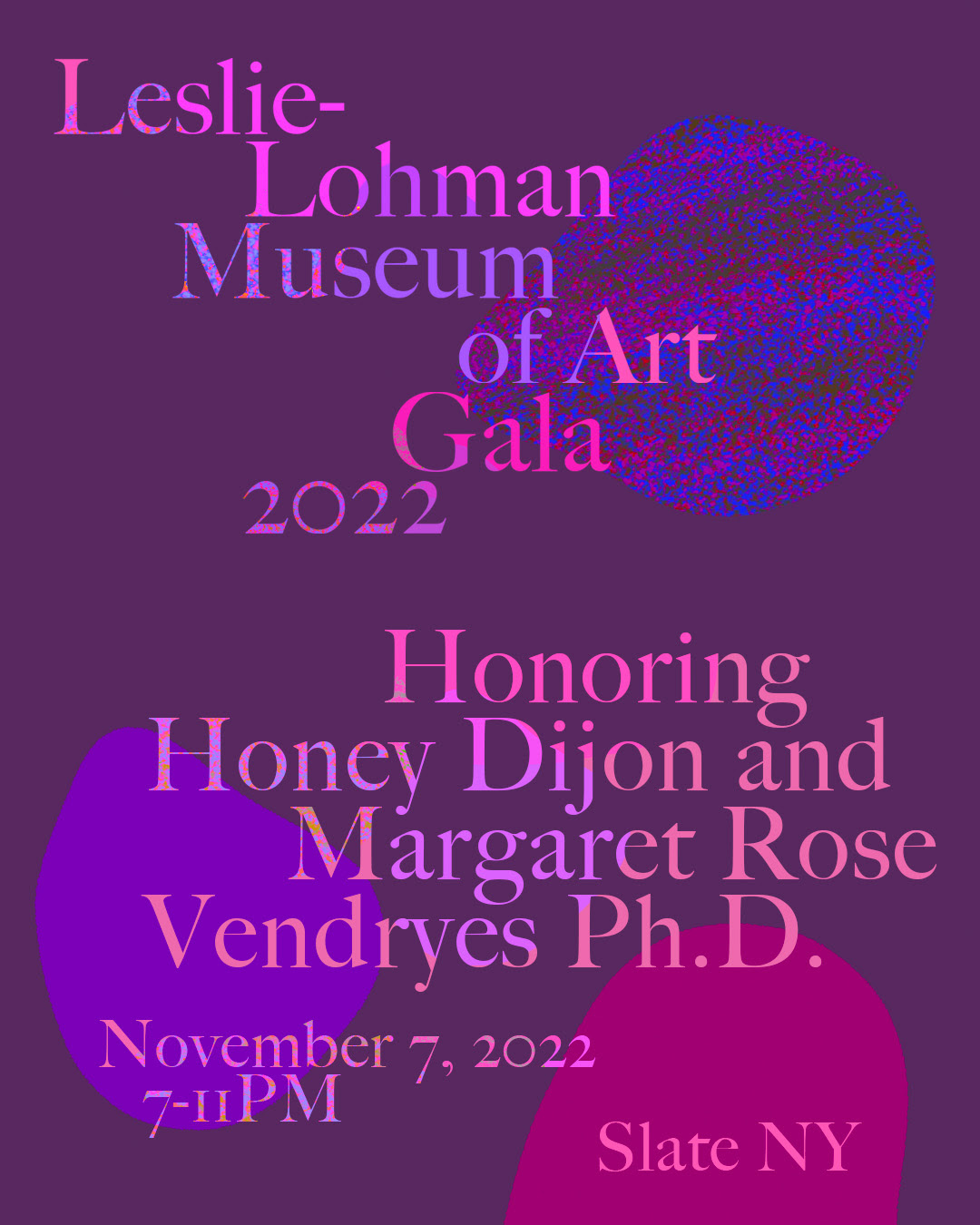
Image Description: An invitation, in various shades of purple and violet, announcing the Leslie-Lohman Museum of Art Gala, honoring Honey Dijon and Margaret Rose Vendryes Ph.D., November 7th, 2022, 7-11PM State NY
We've been busy putting together a gala you won't want to miss. We're honoring the lives and legacies of Margaret Rose Vendreys, Ph.D., and Honey Dijon, and in addition to Jonathan Lyndon Chase creating a special award for Honey Dijon, Myles Loftin, Kimberly Drew, Sarah Burke, and Lady Fag are just a few of the icons that are joining us for the night. There's definitely sure to be more.

The Leslie-Lohman Museum is the only contemporary art museum dedicated to LGBTQIA+ art in the world. Join us for an incredible night of celebration, and a continued investment in queer creativity and futurity. We're building worlds for all of us, together.
Gala Accessibility

Slate is located at 54 W 21st Street, New York, NY 10010. The event will take place on the first and basement level. The entrance and first floor of the venue are wheelchair accessible. The basement is wheelchair accessible by an elevator located one door west from the main entrance. A greeter and elevator attendant will be present for the duration of the event to guide guests and operate the elevator.

Wheelchair accessible restrooms are located on the first and basement levels. Restrooms will be designated and clearly marked as all-gender. 
Lighting for the event will be a mix of incandescent and LED lighting and generally, low-light.

This is a mask optional gathering. ​​Masks will be available at check-in located on the first level. Guests are encouraged to take a COVID-19 test before the event.

Disabled visitors will be admitted with their personal assistant.
ASL interpretation may be provided by Leslie-Lohman Museum of Art with advance notice by emailing info@leslielohman.org at least one week prior to the event.

Please Email info@leslielohman.org for any other access questions or requests.
Museum Accessibility

For in person visits, five external steps lead to our main entrance: a wheelchair lift is available. All galleries are wheelchair-accessible.There is a single-occupancy accessible restroom located behind the visitor services desk. All restrooms are gender-neutral. For requests or more information, please email info@leslielohman.org

The Leslie-Lohman Museum of Art provides a platform for artistic exploration through multi-faceted queer perspectives. We embrace the power of the arts to inspire, explore, and foster understanding of the rich diversity of LGBTQIA+ experiences. Through annual exhibitions, public programs, educational initiatives, artist fellowships, and a journal, LLMA forefronts the interrelationship of art and social justice for LGBTQIA+ communities in NYC and beyond. Our collection includes over 25,000 objects spanning 4 centuries of queer art.
 
The Museum is generously supported, in part, by public funds from Mellon Foundation, The Institute of Museum and Library Services, the New York State Council on the Arts with the support of the Office of the Governor and the New York State Legislature, and the New York City Department of Cultural Affairs in partnership with the New York City Council. Programmatic support is also provided by the Achilles Family Fund; Booth Ferris Foundation; Keith Haring Foundation; John Burton Harter Foundation; and the Henry Luce Foundation. Individual support is proudly provided by the Leslie-Lohman Museum of Art's Board of Trustees and Global Ambassadors.

Thank you to Kartell for their contribution.
Facebook ‌ Twitter ‌ Instagram ‌