Tuesday

Nicola Pisano and his Nativity Scene on the Pulpit of the Baptistry in Pisa Italy, Italian Gothic Sculpture


Form:  According to the Encyclopaedia Britannica,  "The circular baptistery, begun in 1152 but only completed in the 14th century, is covered by a dome surmounted by a cone, which gives the structure an ogival, Oriental effect. The interior contains a wonderful hexagonal pulpit completed in 1260 by Nicola Pisano."

Nicola Pisano. Nativity,
Pulpit from Pisa's Baptistery c1259
Italian Gothic,

Form:  This pulpit exhibits qualities from all three of the eras.   The ornate carving and stylization of the lions and the lions demonstrates both the influence of the Byzantine and Gothic eras.  The classical columns surmounted by Gothic style tracery show those periods styles.Iconography:  This pulpit is the podium from which the priest or brother who resides over the ceremonies and services speaks from.  As such it is elevated as his words must be but the decorations and ornamentation are also iconic of the priest's words and his status. The references to both the classical and gothic styles also lend the work some authority as well.  The sculptures of the eagle and lions at the base have some basis in earlier traditions in which lions and monsters serve an apotropaic (protective) function but in this case, it is possible that the lions could refer to the story of Daniel in the lion's den or to a passage from the the 95th Psalm (read the entire Psalm in "Liaisons"):

For he will command his angels concerning you
to guard you in all your ways;
they will lift you up in their hands,
so that you will not strike your foot against a stone.
You will tread upon the lion and the cobra;
you will trample the great lion and the serpent.
Likewise, the representation of the eagle could be a reference to one of the apostles or again to the psalm:
Surely he will save you from the fowler's snare
and from the deadly pestilence.
He will cover you with his feathers,
and under his wings you will find refuge;
his faithfulness will be your shield and rampart.
Context:  Several generations of the Pisano family had worked in and around the Pisa complex where this was found.  The Catholic Church at this point in time was the major patron of the arts.  It was not unusual for several generations of artists or workers to work on a single church or structure.


Nicola Pisano. Nativity, detail of Baptistery Pulpit panel: Annunciation,
Nativity and Annunciation to Shepherds 1259-60 Italian Gothic,

Pheidias
Pediment of the Parthenon
Three Goddesses c438BCE
Greek Classic,

Form:  This is a relief carving.  The relief varies greatly in the height and or depth of each of the figures and objects.  In general the composition is fairly symmetrical yet it is very crowded and almost seems disorganized.  Most of the figures are placed in the foreground of the picture plane and the space created is not very illusionistic.  Space is created by placing the figures in the foreground lower in the picture plane.  In order to show the recession of space, the figures are layered and the placed in a vertical perspective. The rendering of each of the figures is fairly naturalistic and the clothing, drapery and poses are somewhat reminiscent of carvings such as the this one from the Parthenon's pediment.  Several of the figures, such as the main one which depicts Mary and the child (Jesus) are repeated because several scenes are simultaneously being represented.  This kind of continuous narrative is common in Byzantine, Romanesque, Gothic and Renaissance art.

Iconography:  This is a nativity scene that at first appears to take place in a manger but it also contains the baptism of Christ as well as the annunciation by the angel Gabriel.  The scenes are as follows, far left the angel Gabriel confronts Mary with his annunciation of the birth of Jesus. Mary pulls away towards the center of the scene.  In the upper right hand corner is a manger scene in which Jesus lies in his crib, at the far right are two of the wise men who are missing their heads.  The center of the scene Mary reclines in a pose very reminiscent of the Goddesses from Parthenon.  In the lower left foreground of the image is the baptism of Christ (note he's missing his head too.)

The next major difference is in the style and amount of artwork. In general, the Romanesque style is extremely organized, diagrammatic, and stylized. It tends to take cues from Byzantine art, in which the figures' relative size to another figure is based upon its' importance in the spiritual hierarchy. For example, when Jesus or an Angel is shown, they are relatively larger than all the other figures whom are depicted in a particular scene. This shows how important they are, they loom above the mere mortals, faithful and sinners alike. In contrast, the Gothic style of sculpture and art within a cathedral is very much a "schema and correction" of the Romanesque art. While the same themes and saints may be depicted, they are far more naturalistic, shown more or less in proportion often with detailed, flowing robes which harken back to the Greek ideals of art and beauty. For example, in Stokstad on pg. 594, is a depiction of Dormition of the Virgin from the Strasbourg cathedral in France. Jesus, the virgin, and all the followers are all equal in size and proportion, the only thing that shows Jesus as the most important figure is his place n the center and his halo, otherwise he blends in with the others. There also tends to be more of an emphasis on the stories of Jesus in the Gothic cathedrals, whereas the Romanesque cathedrals tended to emphasize not only Jesus, but biblical stories, morality stories, saints, parables, and virtues.Context:  The realism of her pose and drapery demonstrate the beginnings of the heightened realism that occurs during this period.  These classical references are both "classy" but also refer to the new ideas concerning a more humanistic approach towards interpreting scripture.  The naturalism relates more towards the viewer than ever before and it is possible to imagine the scene as something real.


Sunday


Friday


Giotto's "Madonna Enthroned"

Thursday


Queer|Art|Mentorship 2016-2017 Annual Exhibition: Leslie-Lohman Prince Street Project Space (October 13-15)

Image designed by Virgil B/G Taylor

Queer|Art|Mentorship 2016-2017 Annual Exhibition

"Out of the Past & Into That Fog"


October 13-15, 2017

Leslie-Lohman Prince Street Project Space
127-B Prince Street
MORE INFO HERE
Organized in partnership with the Leslie-Lohman Museum of Gay and Lesbian Art, the 2016-2017 QAM Annual is presented at the Museum’s Prince Street Project Space (127-B Prince St.) fromOctober 13-15th and includes a weekend of screenings, readings, and performances, as well as a gallery exhibition. It features new work by the 2016–2017 Queer|Art|Mentorship Fellows: Chris Blue, Anna Campbell, Ashton Cooper, Emily U. Hashimoto, Heather Lynn Johnson, Jamal T. Lewis, Jordan Martin, Rodrigo Moreira, Christina Quintana (CQ), and Virgil B/G Taylor.

The Queer|Art|Mentorship 2016-2017 Annual Exhibition opens with a public reception on Friday, October 13th from 6-8pm. This night will also include the launch of a limited-edition publication designed by Virgil B/G Taylor and produced in conjunction with the show, with contributions from all participating artists. A special program of screenings, performances, and readings will follow on Saturday, October 14th from 7-9pm. Gallery hours are from 12pm-5pm, Saturday and Sunday.
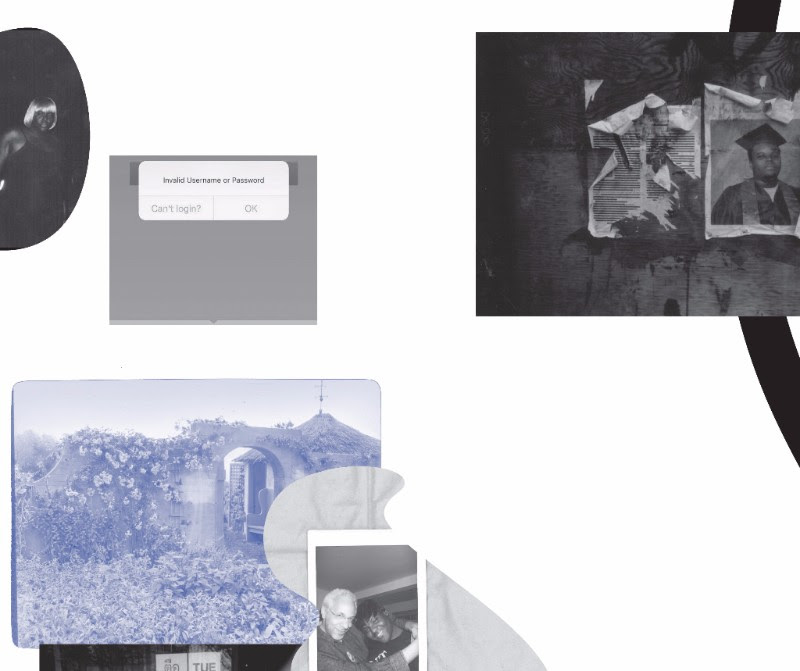
Image designed by Virgil B/G Taylor, with artwork courtesy of Anna Campbell
Into That Fog

Opening Reception: Friday, October 13th, 6-8pm
Open Gallery Hours: Saturday & Sunday, October 14-15th, 12-5pm


The title of this year’s Annual—“Out from the Past & Into that Fog”—refers to the combination of work being exhibited in the gallery as well as during the live event. The exhibition is curated by Ashton Cooper and will feature new work by Chris Blue, Anna Campbell, Jamal T. Lewis, Heather Lynn Johnson, Rodrigo Moreira, and Virgil B/G Taylor. Each of these artists have created work that contends with ideas of obfuscation, concealment, and obscuring in relation to the queer body. Many of the pieces on view engage these ideas through formal means — materials mask one another, shapes supersede text, and words are redacted. Collage, in particular, is used as an obscuring agent across several artists’ practices. Other works approach concealment conceptually by addressing the multivalence of supposedly normative signifiers; surveillance and immigration; and the advantages of refusing to explicitly represent the marginalized body. Repeatedly, the body is absent but evoked.
Image designed by Virgil B/G Taylor, with artwork courtesy of Jamal T. Lewis
Out from the Past

Live Event: Saturday, October 14th, 7-9pm
Doors open at 6pm


During Saturday night’s live event, however, the body will very much be present. The evening is curated by Vanessa Haroutunian, Queer|Art Program Coordinator, and will feature performances, readings, and screenings of new work by Heather Lynn Johnson, Jamal T. Lewis, Emily U. Hashimoto, Christina Quintana (CQ), and Jordan Martin/∂αρнηє. Heather Lynn Johnson will be reading excerpts from “Survival Guide for Black Queer Youth” (Impatient Press, 2017), a poetic guide that utilizes personal dreams, familial history, and life experience. Jamal T. Lewis will be screening a preliminary cut of No Fats, No Femmes, a documentary film about desire, body image, and sexual racism. Emily U. Hashimoto will be reading an excerpt from a new novel, which follows the relationship of two queer women of color over the course of ten years as they grow away from and towards each other. Christina Quintana (CQ) will stage an excerpt from Tobias, a “novel-in-performance” that explores the story of two individuals named Tobias: one, based on the true story of a slave, and the other, a fictional modern New Yorker, both of whom find themselves entangled in a complicated interracial relationship with other men. Throughout the evening performers directed by Jordan Martin/∂αρнηє will be present making special “announcements” as part of the next iteration of Martin’s episodic pedagogy project, Teaching to Transgression: Psycho-Socialite. The work of all five artists speaks to their personal experiences as queer individuals living in the U.S. and how they have grappled with the struggles they and those before them have endured.
Queer|Art|Mentorship is a program organized by Queer|Art that pairs emerging and established LGBTQ artists in a year-long exchange and cultivates a network of shared resources and knowledge among an intergenerational community of artists and arts professionals. Since its launch in 2010, the program has seeded a number of creative and professional relationships that have propelled the careers of a new generation of creators. Its impact is confirmed with the Annual, now in its fourth year, which features work by current Fellows of the program. The work presented here represents projects produced by Fellows with support and guidance from Queer|Art Mentors during the program.
MORE ABOUT QUEER|ART|MENTORSHIP HERE
Facebook
Twitter
Instagram
Website

Tuesday

Queering Queer Abstraction

Queering Queer Abstraction

Ken Gonzales-Day, The Wonder Gaze (St. James Park), 2006. Digital exhibition print on vinyl, dimensions variable. Courtesy Luis De Jesus, Los Angeles, © Ken Gonzales-Day.
 On its surface, Redress (2015) by Lucas Michael refers to nothing specific. The sculpture consists of three neon bands shaped into an open rectangle with the lower line missing; the bands all emit a searing light red hue. Redress is meant to stand against a gallery wall where its luminescence grasps for the neutral tones of the white cube. Like its most immediate predecessor, the neon work of Dan Flavin, Redress seems to function as a formal exercise—a play between supporting architecture and imposed form, between saturated and neutral chromatic tones. But for those who viewed Michael’s piece at the exhibition FOUND: Queer Archaeology; Queer Abstraction, curated by Avram Finkelstein (of Gran Fury fame) at the Leslie-Lohman Museum of Gay and Lesbian Art this past summer, its wall label illuminated a more immediate reference. The artist constructed Redressto follow the dimensions of a door at Commonwealth & Council, a gallery in Los Angeles. Moreover, the red light of the work recalls the red light of clubs, bars, and other nighttime dens. Redress creates a continuum of associations between geometric form and social life.

Monday

News from Bathurst Regional Art Gallery
NSW Minister for the Arts Don Harwin will open the exhibition at 6pm. ... art photography and film, fashion photography, pop videos and homoerotic art.