For all the videos in order with a textbook and study guides please visit:
http://art-and-art-history-academy.usefedora.com/Feel free to participate in the Survey Art History Facebook Group:
https://www.facebook.com/groups/SurveyArtHistory/
Transition from the Romanesque and Byzantine or "Greek Manner" to the Late Gothic and Renaissance Styles in Painting and Sculpture

Bonaventura Berlinghieri,
"St. Francis Altarpiece" 1235
tempera on wood 60' x 42' (approx. 5" x 3.5)
Byzantine Style (maniera greca) painted during the Gothic Period | Form:
This altarpiece is painted in tempera on wood. At five feet, the representation of St. Francis is depicted as nearly life-size. Art of the Byzantine period largely influenced Italian Gothic art. There is no depth to St. Francis. He is two-dimensional and at the front of the picture plane. His feet are not standing on the ground but seem to be floating just above it. Iconography:
St. Francis is situated in the center of the painting - a position usually reserved for Christ or the Virgin Mary. The identification with Christ is further enhanced with the clearly displayed stigmata on his raised blessing hand. The three knots on his rope belt represent chastity, poverty and obedience. He is flanked on either side by angels and is surrounded by boxes containing major events in his life.
Context:
This altarpiece was completed in 1235, less than ten years after Francis’ canonization. St. Francis taught that studying nature was a way to understand God and religious ideas should be discovered through human experience of the world. These observations were partially responsible for the reflection on nature rather than most art of its time and were a prototype for new works. This led to new observations of nature in art and the beginnings of scientific study.
Written by Annette Abbott
Context continued: Many paintings like this have a rather Byzantine flavor or style to how they are painted. This formulaic attempts to emulate Greek icons is what Vasari (an art hsitorian from the late 16th C) called the maniera greca in Italy. |
According to the Brittanica
from Francis Of Assisi, Saint
The Franciscan rule of life. Although he was a layman, Francis began to preach to the townspeople. Disciples were attracted to him, and he composed a simple rule of life for them. In 1209, when the group of friars (as the mendicant disciples were called) numbered 12, they went to Rome to seek the approval of Pope Innocent III, who, although hesitant at first, gave his oral approbation to their rule of life. This event, which according to tradition occurred on April 16, marked the official founding of the Franciscan order. The friars, who were actually street preachers with no possessions of any kind and with only the Porziuncola as a center, preached and worked first in Umbria and then, as their numbers grew, in the rest of Italy.
The early Franciscan rule of life, which has not survived, set as the aim of the new life, "To follow the teachings of our Lord Jesus Christ and to walk in his footsteps." Probably no one in history has ever set himself so seriously as did Francis to imitate the life of Christ and to carry out so literally Christ's work in Christ's own way. This is the key to the character and spirit of St. Francis. To neglect this point is to show an unbalanced portrait of the saint as a lover of nature, a social worker, an itinerant preacher, and a lover of poverty.
Certainly the love of poverty is part of his spirit, and his contemporaries celebrated poverty either as his "lady," in the allegorical Sacrum Commercium (Eng. trans., Francis and His Lady Poverty, 1964), or as his "bride," in the fresco of Giotto in the lower church of S. Francesco at Assisi. It was not, however, mere external poverty he sought but the total denial of self (as in Letter of Paul to the Philippians 2:7).
He considered all nature as the mirror of God and as so many steps to God. He called all creatures his "brothers" and "sisters," and in his "Canticle of the Creatures" (less properly called by such names as the "Praises of Creatures" or the "Canticle of the Sun") he referred to "Brother Sun" and "Sister Moon," the wind and water, and even "Sister Death." His long and painful illnesses were nicknamed his sisters, and he begged pardon of "Brother Ass the body" for having unduly burdened him with his penances. Above all, his deep sense of brotherhood under God embraced his fellow men, for "he considered himself no friend of Christ if he did not cherish those for whom Christ died."
"The Franciscan rule of life.." Britannica 2001 Standard Edition CD-ROM. Copyright © 1994-2001 Britannica.com Inc. November 16, 2002.
Context and Critical points of view: The previous section is a a biography of St. Francis' life however, Francis represents a pivotal figure that represents the transition in thinking between the Gothic period and the Renaissance. Previous to the life of St. Francis, the Catholic Church was the sole source of information about God for the layman (every day non-clergy). The Church interpreted, interceded and imposed a very clear point of view about God's teachings and was the sole source of biblical interpretation. In fact, laymen were not even allowed to own a Bible, not that they could afford one since they were hand written and very expensive. This point of view and religious/political system meant that everyday people could not actually "know" God for themselves and supported and maintained a point of view that one was born to a place on this earth that was unchangeable.
Francis' point of view that "To follow the teachings of our Lord Jesus Christ and to walk in his footsteps." Breaks with this tradition and demonstrates the beginning of a point of view in which the lay person could not only have a direct experience of God but also alter their behavior in accordance with their knowledge without needing to consult the Church for interpretation. This is important and interesting because aside form the ideas exhibited in the teachings of Thomas Aquinas, this represents the beginning of a change in the way of thinking and the stirrings of individual critical thought. The art that follows, after the Byzantine period and in the late Gothic and Early Renaissance exhibits a new and critical point of view of the world.

Virgin and Child,
from the Auvergne region, France. c1150-1200
Oak with polychromy, height 31",
Metropolitan Museum of Art
French Romanesque | Form: This sculpture is both naturalistic and stylized. The rendering of the face and hands was an attempt by the sculptor to represent convincing human forms however, the faces show no real expression and the bodies are completely covered with stylized drapery that conceals both figures bodies. The child Jesus is not rendered as a child buy rather a stiff looking miniature adult. The poses of both figures are stiff and fairly wooden but in the case of Mary, this is appropriate if you look at her role in terms of the work's iconography. Iconography: This image of Mary is significant in it's iconography because it is a perfect example of the Gothic depiction of Mary as the "Throne of Wisdom." Here she not only serves as a mother but as a platform or throne for her child. Stokstad discusses her pose as regal and that her throne like posture is symbolic of the old testament references to the Lion Throne of King Solomon who is known as a wise and fair ruler and judge. See Stokstad for a more complete discussion of the iconography.
Context: Smaller and more portable works like this served as portable symbols of the faith. The iconography associated with such symbols and the creation of smaller and more portable objects grows over time and has a strong influence on the creation of altars and other religious items in the Renaissance. The works of such late Gothic/Early Renaissance artists such as Giotto and his teacher Cimabue are most certainly a product of this era although as we'll see they changed the schema considerably. |
 Cimabue, Virgin and Child Enthroned,
from the Church of Santa Trinita, Florence
c 1280. Tempera and gold on wood, 12' 7"x7'4"
Galleria degli Uffizi, Florence
Byzantine Style (maniera greca)
painted during the Gothic Period | Form: The overall composition of this work is symmetrical. The largest figures of Mary and Jesus are at the center of the composition and they are flanked by two rows of angels overlapped as if they are standing on bleachers. Beneath the structure of the throne are several representations of older men with halos. In order to create space, Cimabue uses the same convention of vertical perspective we saw in Pisano's pulpit. The figures that are highest up in the picture plane are furthest back. This painting was rendered with tempera paint and gold leaf. Tempera is a medium which is made from egg (sometimes just the yolk sometimes the whites) glue and ground up minerals that serve as pigment or colorant. The egg actually glues or binds the pigments to the surface. The paint is applied in small distinct brush strokes that show the brushwork when looked at closely.
According to the Brittanica,
Tempera originally came from the verb temper--that is, "to bring to a desired consistency"; dry pigments are made usable by "tempering" them with a binding and adhesive vehicle. Such painting was distinguished from fresco painting, the colours for which contained no binder. Eventually, after the rise of oil painting, the word gained its present meaning. The standard tempera vehicle is a natural emulsion, egg yolk, thinned with water. Variants of this vehicle have been developed to widen its use. Among the man-made emulsions are those prepared with whole egg and linseed oil, with gum, and with wax.
The special ground for tempera painting is a rigid wood or wallboard panel coated with several thin layers of gesso, a white, smooth, fully absorbent preparation made of burnt gypsum (or chalk, plaster of Paris, or whiting) and hide (or parchment) glue. A few minutes after application, tempera paint is sufficiently resistant to water to allow overpainting with more colour. Thin, transparent layers of paint produce a clear, luminous effect, and the colour tones of successive brushstrokes blend optically. Modern tempera paintings are sometimes varnished or overpainted with thin, transparent oil glazes to produce full, deep-toned results, or they are left unglazed for blond effects.
The background is gold leaf on a wooden panel that has been painted with a a combination of glue and marble dust or chalk referred to as gesso. The gold leaf is then incised and punctured with designs. Gold leaf has also been added to the drapery as a means to highlight the folds.
|
Make sure you read in Stokstad Technique: Cenini on Painting
The rendering of color and value in this painting is fairly limited. There is no distinct source of light and very little tonal variation on the faces or drapery of the individual figures and there are no real differences of character or appearance from one face to the next. Cimabue's rendition of the Virgin is very similar to the one from Auvergne. This painting, like the sculpture, is both naturalistic and stylized. Again the rendering of the face and hands was an attempt by the sculptor to represent convincing human forms however, the faces show no real expression and the bodies are completely covered with an almost Byzantine style of drapery that almost completely conceals both figures' bodies. The child Jesus is not rendered as a child buy rather a stiff looking miniature adult. The poses of both figures are stiff and fairly wooden but in the case of Mary, this is appropriate if you look at her role in terms of the work's iconography.
Iconography: As in the French Gothic sculpture Mary is depicted as the "Throne of Wisdom." The arrangement of the composition places Mary at the center of the image and in the most important location. So the use of symmetry and the placement of figures can indicate their status. Notice that Mary is framed and as such "backed up" by the angels. The less important figures of the prophets are literally beneath her and Jesus.
Color and the gold leaf used also serve as iconographic reminders of Mary and Jesus' status. Gold leaf and red and blue pigments were made from precious stones and materials and are symbols of there status.
Context: Stokstad relates that this work probably set the standard for monumental panel paintings. Cimabue was one of the best known and sought after artists of his day and although he stuck to the old Byzantine conventions of depicting the human figure in a caricaturish manner he was still innovative in his illusionistic techniques. He was also an artist of the times and the production and patronage concerning such works of art was going through a bit of a change at the end of the Gothic era.
Artist's during the late Gothic and early Renaissance periods were reliant on three major groups for patronage, the church, the aristocracy and the new wealthy merchant class. Wealthy merchants, such as the Enrico Scrovegni, often would contribute frescoes and altar paintings to churches as a form of indulgence. Often these merchants were wealthy enough to and commission artists to decorate a private altar for their own homes.
During the Gothic period, artists and fine furniture makers were on the same social and economic level. Each group belonged to guilds that one paid dues to and were governed by certain rules. A master who would often have a group of assistants and apprentices working for them ran these shops. Apprentices were children anywhere between the ages of 11-20 years old. Sometimes the parents of a child would pay the master of a shop a monthly or yearly fee in order for the master to teach the child a trade. The child was expected to do work in the shop and when they had earned enough respect or mastery of skills, the master would then advance them on to more complex tasks. After learning these skills for a long enough time, an exceptional child might learn enough to open their own shop; however, some apprentices, as adults remained as an assistant in their master's shop.
How Paintings were commissioned and bought.
The patron and artist negotiate the price. The cost is established by how many figures are present in the painting, the size, the amount of gold leaf and the colors that are used.
The artist orders a wood panel from a furniture maker. It is very important that the wood is "gassed out." This means the older the wood, the more petrified, the better. This can be the most expensive part.
Panel is prepared by apprentices or an assistant by coating it with gesso. Gesso is a mixture of chalk or calcium carbonate (marble dust) mixed with rabbit skin glue.
Now the paint is made. For tempera, egg yolk is mixed with ground-up minerals (sometimes even semiprecious stones) to make a very durable paint.
When all this is done and the painting is complete, there is a procession from the artist's studio to the church.
At this time the altarpiece for the high altar was finished and the picture which was called the "Madonna with the large eyes" or Our Lady of Grace, that now hangs over the altar of St. Boniface, was taken down. Now this Our Lady was she who had hearkened to the people of Siena when the Florentines were routed at Monte Aperto, and her place was changed because the new one was made, which is far more beautiful and devout and larger, and is painted on the back with the stories of the Old and New Testaments. And on the day that it was carried to the Duomo the shops were shut, and the bishop conducted a great and devout company of priests and friars in solemn procession, accompanied by the nine signiors, and all the officers of the commune, and all the people, and one after another the worthiest with lighted candles in their hands took places near the picture, and behind came the women and children with great devotion. And they accompanied the said picture up to the Duomo, making the procession around the Campo, as is the custom, all the bells ringing joyously, out of reverence for so noble a picture as this. And this picture Duccio di Niccolò the painter made, and it was made in the house of the Muciatti outside the gate a Stalloreggi . And all that day persons, praying God and His Mother, who is our advocate, to defend us by their infinite mercy from every adversity and all evil, and keep us from the hands of traitors and of the enemies of Siena. This account reminds us how we should remember the integral role of a major work like this in the civic life of the city. Notice also how the adoration devoted to this new image is comparable to that shown the relics of a patron saint of a community. It is important to remember that the Virgin was the patron saint of Siena, and as such she was the center of the civic and religious life of the city. Kneeling beside the throne of the Virgin are the other patron saints of Siena: Ansanus, Sabinus, Crescentius, and Victor. The order of the altarpiece and the privileged position given to the Sienese saints, especially the Virgin, would have been clearly understood to reflect the ideal order of the city of Siena which would stand before it in the Duomo. The civic implications are further brought out by the original inscription: HOLY MOTHER OF GOD BESTOW PEACE ON SIENA AND SALVATION ON DUCCIO WHO PAINTED THEE.
The reference in the account above to the Madonna with the Large Eyes , or in Italian --Madonna degli Occhi Grossi-- relates to a painting done about 1200:
 This work was seen to be a miracle working image. The Sienese appeals to this image of their patron saint were believed to have lead to the salvation of the city from the Florentines in the Battle of Montaperti in 1260. Why do you think the Sienese would have wanted to have replaced such a revered image with the Duccio altarpiece?
quoted directly from:
Make sure you read in Stokstad Technique: Cenini on Painting
|

Giotto di Bondone, Virgin and Child Enthroned,
(Ognissanti Altar,) c 1310.
Tempera and gold on wood, 10'8"x6'8"
Galleria degli Uffizi, Florence
Late Gothic or Early Renaissance
|
Form: Giotto's painting of the Virgin child shows some marked formal differences. Giotto is a kind of special effects master. His paintings are more three dimensional. He also uses more contrasts of light and shadow. This is called chiaroscuro. He also uses overlapping of the figures to create a sense of space. Compare to Duccio or Cimabue's paintings in which the figures that accompany Mary seem to be standing on bleachers as if for a class photo. Giotto also uses more life like gestures. The figures interact and tend to regard one another. Notice the tilted heads in adoration of the Virgin. The figure of Mary is more life like and even dresses more in the Italian style. Notice her hair is slightly uncovered and her clothing reveals the anatomy beneath almost like the wet drapery style of the ancient Greeks. The throne is also more convincingly rendered it looks looks like an actual architectural structure. Iconography: In an overt description of the iconography Giotto's rendition of this then seems identical to Cimabue's but on closer inspection, the naturalism and illusionism of the work is symbolic of some of the fundamental changes that were occurring during the late Gothic to Renaissance periods.
The naturalism relates to the study and pursuit of humanism. The ideas of Christian and Catholic though go through a radical change with the canonization of St. Francis. The idea that one should and could emulate the life and behavior of Christ meant that art needed to relate more to the individual and strike a chord of compassion. The heightened realism of such images were designed to create a sense of sympathy or empathy with the religious characters they portrayed.
Context: Giotto was the student of Cimabue and considered a genius by Michelangelo and other later Renaissance painters. Make sure you read about his life in "Liaisons." |
According to the Brittanica,
Tempera
A tempera medium is dry pigment tempered with an emulsion and thinned with water. It is a very ancient medium, having been in constant use in most world cultures, until in Europe it was gradually superseded, during the Renaissance, by oil paints. Tempera was the original mural medium in the ancient dynasties of Egypt, Babylonia, Mycenean Greece, and China and was used to decorate the early Christian catacombs. It was employed on a variety of supports, from the stone stelae (or commemorative pillars), mummy cases, and papyrus rolls of ancient Egypt to the wood panels of Byzantine icons and altarpieces and the vellum leaves of medieval illuminated manuscripts. True tempera is made by mixture with the yolk of fresh eggs, although manuscript illuminators often used egg white and some easel painters added the whole egg. Other emulsions have been used, such as casein glue with linseed oil, egg yolk with gum and linseed oil, and egg white with linseed or poppy oil. Individual painters have experimented with other recipes, but few of these have proved successful; all but William Blake's later tempera paintings on copper sheets, for instance, have darkened and decayed, and it is thought that he mixed his pigment with carpenter's glue.
Distemper is a crude form of tempera made by mixing dry pigment into a paste with water, which is thinned with heated glue in working or by adding pigment to whiting, a mixture of fine-ground chalk and size. It is used for stage scenery and full-size preparatory cartoons for murals and tapestries. When dry, its colours have the pale, mat, powdery quality of pastels, with a similar tendency to smudge. Indeed, damaged cartoons have been retouched with pastel chalks.
Egg tempera is the most durable form of the medium, being generally unaffected by humidity and temperature. It dries quickly to form a tough film that acts as a protective skin to the support. In handling, in its diversity of transparent and opaque effects, and in the satin sheen of its finish, it resembles the modern acrylic resin emulsion paints.
Traditional tempera painting is a lengthy process. Its supports are smooth surfaces, such as planed wood, fine set plaster, stone, paper, vellum, canvas, and modern composition boards of compressed wood or paper. Linen is generally glued to the surface of panel supports, additional strips masking the seams between braced wood planks. Gesso, a mixture of plaster of paris (or gypsum) with size, is the traditional ground. The first layer is of gesso grosso, a mixture of coarse, unslaked plaster and size. This provides a rough, absorbent surface for ten or more thin coats of gesso sotile, a smooth mixture of size and fine plaster previously slaked in water to retard drying. This laborious preparation results, however, in an opaque, brilliant white, light-reflecting surface, similar in texture to hard, flat icing sugar.
The design for a large tempera painting traditionally was executed in distemper on a thick paper cartoon. The outlines were pricked with a perforating wheel so that when the cartoon was laid on the surface of the support, the linear pattern was transferred by dabbing, or "pouncing," the perforations with a muslin bag of powdered charcoal. The dotted contours traced through were then fixed in paint. Medieval tempera painters of panels and manuscripts made lavish use of gold leaf on backgrounds and for symbolic features, such as haloes and beams of heavenly light. Areas of the pounced design intended for gilding were first built up into low relief with gesso duro, the harder, less absorbent gesso compound used also for elaborate frame moldings. Background fields were often textured by impressing the gesso duro, before it set, with small, carved, intaglio wood blocks to create raised, pimpled, and quilted repeat patterns that glittered when gilded. Leaves of finely beaten gold were pressed onto a tacky mordant (adhesive compound) or over wet bole (reddish-brown earth pigment) that gave greater warmth and depth when the gilded areas were burnished.
Colours were applied with sable brushes in successive broad sweeps or washes of semitransparent tempera. These dried quickly, preventing the subtle tonal gradations possible with watercolour washes or oil paint; effects of shaded modelling had therefore to be obtained by a crosshatching technique of fine brush strokes. According to the Italian painter Cennino Cennini, the early Renaissance tempera painters laid the colour washes across a fully modelled monochrome underpainting in terre vert (olive-green pigment), a method developed later into the mixed mediums technique of tempera underpainting followed by transparent oil glazes.
The luminous gesso base of a tempera painting, combined with the accumulative effect of overlaid colour washes, produces a unique depth and intensity of colour. Tempera paints dry lighter in value, but their original tonality can be restored by subsequent waxing or varnishing. Other characteristic qualities of a tempera painting, resulting from its fast drying property and disciplined technique, are its steely lines and crisp edges, its meticulous detail and rich linear textures, and its overall emphasis upon a decorative flat pattern of bold colour masses.
The great Byzantine tradition of tempera painting was developed in Italy in the 13th and 14th centuries by Duccio di Buoninsegna and Giotto. Their flattened picture space, generously enriched by fields and textures of gold leaf, was extended by the Renaissance depth perspectives in the paintings of Giovanni Bellini, Piero della Francesca, Carlo Crivelli, Sandro Botticelli, and Vittore Carpaccio. By that time, oil painting was already challenging the primacy of tempera, Botticelli and some of his contemporaries apparently adding oil to the tempera emulsion or overglazing it in oil colour.
Following the supremacy of the oil medium during succeeding periods of Western painting, the 20th century saw a revival of tempera techniques by such U.S. artists as Ben Shahn, Andrew Wyeth, and George McNeil and by the British painter Edward Wadsworth. It would probably have been the medium also of the later hard-edge abstract painters had the new acrylic resin paints not proved more easily and quickly.
Gesso according to the Brittanica,
(Italian: "gypsum," or "chalk"), fluid, white coating composed of plaster of paris, chalk, gypsum, or other whiting mixed with glue, applied to smooth surfaces such as wood panels, plaster, stone, or canvas to provide the ground for tempera and oil painting or for gilding and painting carved furniture and picture frames. In Medieval and Renaissance tempera painting, the surface was covered first with a layer of gesso grosso (rough gesso) made with coarse, unslaked plaster, then with a series of layers of gesso sottile (finishing gesso) made with fine plaster slaked in water, which produced an opaque, white, reflective surface. In the 14th century, Giotto, the notable Italian painter, used a finishing gesso of parchment glue and slaked plaster of paris. In medieval tempera painting, background areas intended for gilding were built up into low relief with gesso duro (hard gesso), a less absorbent composition also used for frame moldings, with patterns often pressed into the gesso with small carved woodblocks. Modern gesso is made of chalk mixed with glue obtained from the skins of rabbits or calves.
Giotto and the Arena Chapel
Enrico Scrovegni
 | Context: A quick overview provided by Brittanica:
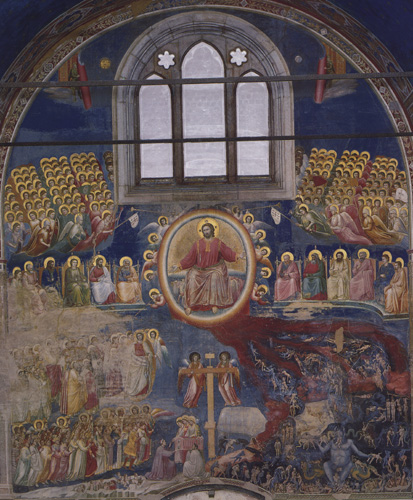
Giotto's Arena Chapel 1305-1306 also called Scrovegni Chapel (consecrated March 25, 1305), small chapel built in the first years of the 14th century in Padua, Italy, by Enrico Scrovegni and containing frescoes by the Florentine painter Giotto. A "Last Judgment" covers the entire west wall. The rest of the chapel is covered with frescoes in three tiers representing scenes from the lives of Saints Joachim and Anna, the life of the Virgin, the Annunciation, and the Life and Passion of Christ, concluding with the Pentecost. Below the three narrative bands is a fourth containing monochrome personifications of the virtues and vices. The frescoes were completed in or before 1309, and they are generally dated about 1305-06. There is thus no very generally agreed picture of Giotto's early development. It is some relief, therefore, to turn to the fresco cycle in the chapel in Padua known as the Arena or Scrovegni Chapel. Its name derives from the fact that it was built on the site of a Roman amphitheatre by Enrico Scrovegni, the son of a notorious usurer mentioned by Dante. The founder is shown offering a model of the church in the huge "Last Judgment," which covers the whole west wall.
"Arena Chapel." Britannica 2001 Standard Edition CD-ROM. Copyright © 1994-2001 Britannica.com Inc. November 16, 2002.
|
 |
The rest of the small, bare church is covered with frescoes in three tiers representing scenes from the lives of Joachim and Anna, the life of the Virgin, the Annunciation (on the chancel arch), and the life and Passion of Christ, concluding with Pentecost. Below these three narrative bands is a fourth containing monochrome personifications of the Virtues and Vices. The chapel was apparently founded in 1303 and consecrated on March 25, 1305. It is known that the frescoes were completed in or before 1309, and they are generally dated c. 1305-06, but even with several assistants it must have taken at least two years to complete so large a cycle. The frescoes are in relatively good condition, and all that has been said of Giotto's power to render the bare essentials of a setting with a few impressive and simple figures telling the story as dramatically and yet as economically as possible is usually based on the narrative power that is the fundamental characteristic of these frescoes. These dominating figures, simple and severe, similar to those in the Assisi cycle but placed in settings of more formal abstraction and rendered with more grandeur, are the quintessence of his style, and anatomy and perspective were used--or even invented--by him as adjuncts to his narrative gifts. He never attained to the skill that so often, in fact, misled the men of the 15th and 16th centuries. In the Padua frescoes the details are always significant, whereas it is a characteristic of the Assisi cycle that there occurs from time to time a delighted dwelling on details that are not absolutely essential to the story.
"Paduan period." Britannica 2001 Standard Edition CD-ROM. Copyright © 1994-2001 Britannica.com Inc. November 16, 2002.
|
 | Form: The frescos are executed in a combination of buon fresco and fresco secco. According to Webster's Dictionary, fresco is "the art of painting on freshly spread moist lime plaster with water-based pigments." Fresco is a term that literally means "fresh." There are two kinds, buon fresco and fresco secco. This painting painting is made by coating a wall with plaster and while the wall is still damp, ground up pigments are mixed with water and lime and painted on the wall. The paint soaks in and literally stains the wall up to a half an inch and becomes permanent. This is called buon fresco (good fresh). Details with more expensive colors (such as blue made from lapis lazuli) are added with tempera paint (egg yolks and glue) when the fresco is dry. This is called secco fresco (dry fresh).
This technique was first developed in Rome and you can still see some really good examples of early fresco dating from 79 CE in Pompeii.
The arrangement of the frescoes in the Arena Chapel actually adds to the frescoes meanings. In order to better understand the frescoes art historians use a the same theory that literary analysts do to study the interrelationship of the stories or narratives. This kind of analysis is called a semiotic or structural analysis. By looking at this wall as a whole, and interpreting the relationship of panel image to the others, it is possible to come up with a deeper understanding of the set of frescoes as a whole.
For example, the top set of images represents scenes from the life of Joachim, Mary's father. This top set of scenes acts as a kind of thematic framework in which to view the life of Jesus which is set in the central section, beneath these stories, acting almost like a foundation or the caryatids from the Acropolis are the seven virtues and vices. See the diagram below. |
 | Scenes from the Life of Joachim
1. Expulsion of Joachim from the Temple
2. Joachim among the Shepherds
3. Annunciation to St. Anne
4. Joachim's Sacrificial Offering
5. Joachim's Dream
6. Meeting at the Golden Gate Scenes from the Life of the Virgin
7. The Birth of the Virgin
8. Presentation of the Virgin in the Temple
9. The Rods Brought to the Temple
10. Prayer of the Suitors
11. Marriage of the Virgin
12. The Wedding Procession
13. God Sends Gabriel to the Virgin
14. Annunciation: The Angel Gabriel Sent by God
15. Annunciation: The Virgin Receiving the Message
16. Visitation
Scenes From the Life of Christ
17. Nativity: Birth of Jesus
18. Adoration of the Magi
19. Presentation at the Temple
20. Flight into Egypt
21. Massacre of the Innocents
22. Christ among the Doctors
23. Baptism of Christ
24. Marriage at Cana
25. Raising of Lazarus
26. Entry into Jerusalem
27. Expulsion of the Money-changers from the Temple
28. Judas Receiving Payment for his Betrayal
29. Last Supper
30. Washing of Feet
31. Kiss of Judas
32. Christ before Caiaphas
33. Flagellation
34. Road to Calvary
35. Crucifixion
36. Lamentation (The Mourning of Christ)
37. Resurrection (Noli me tangere)
38. Ascension
39. Pentecost |
 | Virtues and Vices
Justice and Injustice Form: This is a monochromatic fresco. It resembles a marble relief sculpture. Giotto's genius is also seen in his perspective and visual depth. Light and shadow of the gown she wears resembles the type of gown a Roman woman would wear. Perhaps this is an allusion to Roman art and law. The personification of Justice (as well as Injustice) is slightly larger than the rest of the vices and virtues.
Giotto uses chiaroscuro (the play of light and shadow or shading) to create realism in this work. The drapery is no longer rendered in the cartoonish or awkward manner of earlier paintings and the light source seems consistent across the entire picture plane.
Iconography: The pointed domes surrounding her throne resemble the arches of a gothic cathedral. Though wearing a crown that is a symbol of royalty, this religious backdrop would indicate that she is Godly. Some people also believe that this is Mary. The procession of people at the bottom of this image shows people living prosperous lives. They are dancing, tending their animals and conversing amongst themselves. The lesson being subtly portrayed would be that if one lives a moral life, he will enjoy happiness and prosperity.
Context: Literacy of the Middle Ages was very low. Only the clergy could read the scriptures. Therefore, the paintings inside the temples during this period were for didactic purposes. They were meant to tell a story. In the Arena Chapel the stories are of Jesus’ parents, His life, and then running around the bottom of the church (at eye level) are the Virtues and Vices so that all could see them. Virtues consisted of: Justice (above) prudence, fortitude, temperance, faith, charity, and hope.
by Annette Abbotte |
 | Form: Marble during this period was very expensive, so to cut down on costs, Giotto painted the virtues and vices in a way that made them look like marble. It is also a monochromatic fresco. Though he sits quite close to the fore of the picture plane, Giotto's use of light, shadow and perspective make this ruler appear to be receding beneath the arches of his throne. Iconography: The crumbling castle that serves as a backdrop to this ruler’s throne would suggest that he is a tyrant. He rules his kingdom with a sword. There are trees growing up in front of him. They symbolize the idiomatic expression of one not being able to “see the forest for the trees” – not that this is of any value because, with his head tilted away from the viewer, it appears as if he does not wish to see them at all. The procession of people running along the bottom of this painting indicates these people live in a place of unrest - perhaps a civilization in decline. We see them pillaging, stealing and fighting amongst each other.
Context: The seven vices are personified on one side of the temple facing the virtues. The vices are: Injustice, desperation, envy, infidelity, wrath, inconstancy and foolishness.
Semiotic or structural analysis: The seven vices and virtues are positioned around lowest part of the cathedral. They are intentionally at eye level so that every man who enters the temple can look at and be reminded of the constant and equal struggle of these characteristics in everyone. Justice and Injustice both occupy a central position on the dado. The inside of the Arena Chapel is a didactic text. The higher the eye rises when viewing these frescos, the loftier are the images or stories being portrayed. We can look up to see Christ's parents and his life, but then when we look at the images on the bottom – the ones nearest to ourselves, we see our own souls. The Virtues are on the right side of the chapel. The right in such paintings always represents good (“right hand of God”) or Godliness. The Vices are located along the left side.
by Annette Abbotte
Take a virtual tour of the Arena chapel here:
http://www.mystudios.com/gallery/giotto/preamble.html |
 
St. Lazare, Autun Cathedral, France
West Portal, sculpted by Gislebertus c1130CE
| Form: Compare this image to Gislebertus' carving at Autun Cathedral. The composition is symmetrical and organized using hieratic scale. The picture plane is also organized according to horizontal bands but in this image, unlike its Romanesque predecessor, there is overlapping and some sense of space created. The structure of the composition is still standard according to depictions of a "Last Judgment." According to the Brittanica,
Typically, the figure of Christ appears in the centre of the composition, dominant in size and usually enclosed in a mandorla (an oval, nimbus-like form). At his right and left are the four Evangelists, sometimes represented or accompanied by their animal symbols. To the sides, smaller figures of angels and demons weigh sins of the resurrected dead, who are ranked along the lowest and smallest section of the tympanum, directly above the lintel.
Iconography: What makes St. Lazare an interesting example of Romanesque architecture and art is the fact that the west portal, which depicts a "sermon in stone," was originally painted. It is exceedingly well organized and stylized. This means that the figures represented in the relief sculpture are non naturalistic, this is akin to what one would see in Byzantine art. The figures relative size is based not on reality, but on their spiritual importance.
Jesus, as the central figure is shown impossibly huge the figures around him are depicting judgment, heaven and hell, and good and evil. The organization of the composition is designed so that all of the other figures relate in some way to the central figure of Jesus. Figures who are to the right of Christ are literally on his good side while the figures to his left are not. Likewise there is a hierarchy according to placement in the three bands. The correlation between left and right (good and evil) does not exist in the topmost band. Anything placed in the uppermost register of the composition is "good" or heavenly.
According to the Brittanica,
Christianity, further developing the concept of the Last Judgment, teaches that it will occur at the Parousia (the Second Coming, or Second Advent, of Christ in glory), when all men will stand before a judging God. In early Christian art the scene is one of Christ the judge, the resurrection of the dead, the weighing of souls, the separation of the saved and the damned, and representations of paradise and hell. Romanesque artists produced a more terrible vision of the Last Judgment: Christ is shown as a stern judge, sometimes carrying a sword and surrounded by the four mystical beasts--eagle, lion, ox, and winged man--of the apocalypse; the contrast between paradise and hell is between the awesome and the ferocious. In the gentler, more humanistic art of the Gothic period, a beautiful Christ is shown as the Redeemer, his right side undraped to reveal the wound of the lance, and both wounded hands raised high in a gesture that emphasizes his sacrifice. He is surrounded by the instruments of his Passion--cross, nails, lance, and crown of thorns. The intercessors are restored, and the scene of the Judgment is treated with optimism. In the 16th century, Michelangelo produced a radically different version of the Last Judgment in his fresco in the Sistine Chapel in Rome (1533-41): a vengeful Christ, nude like a pagan god, gestures menacingly toward the damned.
|
 | The iconography of this "Last Judgment" does change a bit also by the inclusion of the patron of the image just to the left of center (Christ's right.) The inclusion of a patron or donor to the chapel actually is very significant, it tells us that there is a new class of people on the scene and that they consider themselves important. It also indicates some ideas concerning the sale of indulgences and usury that are later on considered suspicious during the 1500's. See professor Farber's page for a more complete discussion. Dr. Farber's Lecture on the Arena Chapel
Below the cross, on the left, is the dedicatory scene, in which Enrico Scrovegni kneels before the Virgin and two saints, offering a model of the Arena Chapel upheld by an Augustinian friar. The portrait of Scrovegni, who is shown in sharp profile, is a faithful representation of the youthful features of the same man shown in old age on his marble tomb in the same chapel. His clothing and hair style reflect the fashions of the day, and provide valuable information on contemporary costume. The figure of Scrovegni is on the same scale as the sacred figures he is addressing - it was evidently enough to show him kneeling before these figures to indicate his 'inferior' status. The model of the chapel presented by Scrovegni differs in a few details from the real chapel, a fact which suggests that the Last Judgment may have been painted before the exterior of the chapel was completed. This is a strong possibility since the most pictorially advanced parts of the cycle, i.e. those most similar to Giotto's later works, appear on the wall opposite the Last Judgment, above and on each side of the chancel arch. The warm, rich coloures of the angels surrounding God, and of the figures of Gabriel and Mary are related to the fresco decorations in the Magdalen Chapel in the Lower Church at Assisi, which are the closest to the Paduan frescoes of all of Giotto's surviving cycles.
http://www.kfki.hu/~arthp/tours/giotto/lastjudg.html
Context: According to Professor Farber,
In 1300, the wealthy Paduan merchant Enrico Scrovegni bought a piece of land on the site of a former Roman arena. Included in the palace that he built on the site was a chapel dedicated to the Virgin of the Annunciation, Santa Maria Annunziata, and the Virgin of Charity, Santa Maria del Carità. Enrico is shown in the fresco of the Last Judgment presenting a model of the chapel to the Virgin: The family wealth had been amassed by Enrico's father, Reginaldo, whom Dante singled out as the arch usurer in his Inferno. Usury, the lending of money for profit, was considered a sin during the Middle Ages. It is likely that Enrico constructed the chapel as a means to expiate the father's sin. The dedication of the Chapel to the Virgin of Charity, referred to in a document of March of 1304 in which Pope Benedict XI granted indulgences to those who visited "Santa Maria del Carità de Arena," was an obvious choice to disassociate the family from taint of greed and miserliness.
|

 | Form: This is a detail of the lower right hand corner (to Christ's left) of the Last Judgment. In this section the coloring shifts radically with its flames and lava. The figure of the devil is placed in the center of the sub region of hell.
Iconography:
The damned, who are shown in the lower right hand corner, fall into a hell dominated by the figure of Satan. This hell teems with hopeless diminutive figures being subjected to a variety of comically indecent humiliations and torments by apish devils. It is a far cry from Dante's tragic vision of hell and recalls only a few verses of the Inferno about the area of hell known as the Malebolge. Almost all these figures can be attributed to Giotto's assistants, though here, too, the guiding hand of the master can be perceived in the rich play of imagination which characterizes the whole, and in the execution of certain parts, which suggest his direct intervention. This is true of the wonderfully immediate episode that takes place on the brink of hell, below the cross, where two devils conduct a struggling man back to the damned, tugging him by his clothes, which are being pulled over his head to reveal his disproportionate genitals. (It seems these two sites copied from each other, I'm not sure which is the original source so here's links to both.)
http://gallery.euroweb.hu/html/g/giotto/padova/4lastjud/lastj_d4.html
http://www.kfki.hu/~arthp/tours/giotto/lastjudg.html
According to Dr. Farber, In hell . . .
the theme of usury is also developed in the adjacent image of Christ expelling the merchants from the Temple and the detail of usurers hanging from the their money bags in the Hell scene included in the Last Judgment:
|
Giotto's walls and paintings are done in fresco, According to the Brittanica,
Fresco is a method of painting water-based pigments on freshly applied plaster, usually on wall surfaces. The colours, which are made by grinding dry-powder pigments in pure water, dry and set with the plaster to become a permanent part of the wall. Fresco painting is ideal for making murals because it lends itself to a monumental style, is durable, and has a matte surface. Buon', or "true," fresco is the most durable technique and consists of the following process. Three successive coats of specially prepared plaster, sand, and sometimes marble dust are troweled onto a wall. Each of the first two rough coats is applied and then allowed to set (dry and harden). In the meantime, the artist, who has made a full-scale cartoon (preparatory drawing) of the image that he intends to paint, transfers the outlines of the design onto the wall from a tracing made of the cartoon. The final, smooth coat (intonaco) of plaster is then troweled onto as much of the wall as can be painted in one session. The boundaries of this area are confined carefully along contour lines, so that the edges, or joints, of each successive section of fresh plastering are imperceptible. The tracing is then held against the fresh intonaco and lined up carefully with the adjacent sections of painted wall, and its pertinent contours and interior lines are traced onto the fresh plaster; this faint but accurate drawing serves as a guide for painting the image in colour.
A correctly prepared intonaco will hold its moisture for many hours. When the painter dilutes his colours with water and applies them with brushstrokes to the plaster, the colours are imbibed into the surface, and as the wall dries and sets, the pigment particles become bound or cemented along with the lime and sand particles. This gives the colours great permanence and resistance to aging, since they are an integral part of the wall surface, rather than a superimposed layer of paint on it. The medium of fresco makes great demands on a painter's technical skill, since he must work fast (while the plaster is wet) but cannot correct mistakes by overpainting; this must be done on a fresh coat of plaster or by using the secco method.
Secco ("dry") fresco is a somewhat superficial process that dispenses with the complex preparation of the wall with wet plaster. Instead, dry, finished walls are soaked with limewater and painted while wet. The colours do not penetrate into the plaster but form a surface film, like any other paint. Secco has always held an inferior position to true fresco, but it is useful for retouching the latter.
The origins of fresco painting are unknown, but it was used as early as the Minoan civilization (at Knossos on Crete) and by the ancient Romans (at Pompeii). The Italian Renaissance was the great period of fresco painting, as seen in the works of Cimabue, Giotto, Masaccio, Fra Angelico, Correggio, and many other painters from the late 13th to the mid-16th century. Michelangelo's paintings in the Sistine Chapel and Raphael's Stanza murals in the Vatican are the most famous of all frescoes. By the mid-16th century, however, the use of fresco had largely been supplanted by oil painting. The technique was briefly revived by Diego Rivera and other Mexican Muralists in the first half of the 20th century.

Christ Entering Jerusalem 
Duccio di Buoninsegna, (Maestà)
detail Christ Entering Jerusalem
(Maestà, reverse of the top panel called "verso")
1308-11Tempera on wood
Museo dell'Opera del Duomo, Siena | Form: Giotto is known for his ability to create a rational sense of space, even though he hasn't really formulated or learned the laws of perspective as they are known by 1400. He does use vertical perspective to create space initially. He places the figures that are closest to the viewer the lowest in the picture plane and those further back higher up but, he places the figures more on a horizontal and logical plane.
He also uses overlapping and a size scale difference between foreground and background. Some of the figures in the crowd overlap and hide the figure's behind them. The figures in the background are significantly smaller but the scale of the building is a bit illogical.
Compare this image to Duccio's rendition of the same image.
Giotto also uses chiaroscuro (the play of light and shadow or shading) to create realism in this work. According to the Brittanica, chiaroscuro (from Italian chiaro, "light"; scuro, "dark"), which is technique employed in the visual arts to represent light and shadow as they define three-dimensional objects. The drapery is no longer rendered in the cartoonish or awkward manner of earlier paintings and the light source seems consistent across the entire picture plane.
Context: In order to understand the iconography of this scene one needs to go to the Bible passage on which it is modeled first:
Matthew Chapter 21
- 1
- When they drew near Jerusalem and came to Bethphage on the Mount of Olives, Jesus sent two disciples,
- 2
- saying to them, "Go into the village opposite you, and immediately you will find an ass tethered, and a colt with her. Untie them and bring them here to me.
- 3
- And if anyone should say anything to you, reply, 'The master has need of them.' Then he will send them at once."
- 4
- This happened so that what had been spoken through the prophet might be fulfilled:
- 5
- "Say to daughter Zion, 'Behold, your king comes to you, meek and riding on an ass, and on a colt, the foal of a beast of burden.'"
- 6
- The disciples went and did as Jesus had ordered them.
- 7
- They brought the ass and the colt and laid their cloaks over them, and he sat upon them.
- 8
- The very large crowd spread their cloaks on the road, while others cut branches from the trees and strewed them on the road.
- 9
- The crowds preceding him and those following kept crying out and saying: "Hosanna to the Son of David; blessed is he who comes in the name of the Lord; hosanna in the highest."
- 10
- And when he entered Jerusalem the whole city was shaken and asked, "Who is this?"
11 And the crowds replied, "This is Jesus the prophet, from Nazareth in Galilee."
Iconography: Most of the iconography is fairly standard in this image. Jesus is depicted in he usual manner, he has a beard and is depicted, as his apostles with a beautiful nimbus of gold around his head. His halo is literally the light of divine knowledge which radiates from him. The royal red and blue colors he wears and the gold leaf are all meant to emphasize his status, however, he is also humble. He rides a common beast of burden to show his connection to all men. However, Giotto has a sense of humor about the whole thing. If you look at the figure in the far right hand corner of Giotto's image, you may notice that one of the figures seems to be having some trouble removing his cloak. |

Giotto, The Lamentation, c1305 Arena Chapel, Padua, Italy ¹la.ment vb [ME lementen, fr. MF & L; MF lamenter,
fr. L lamentari, fr. lamentum, n., lament] vi (15c): to mourn aloud:
wail ~ vt 1: to express sorrow, mourning, or regret for often
demonstratively: mourn 2: to regret strongly syn see deplore
²lament n (1591) 1: a crying out in grief: wailing 2: dirge, elegy
3: complaint | Form: Giotto is known for his ability to create a rational sense of space, even though he hasn't really formulated or learned the laws of perspective as they are known by 1400. In this image, he does not really rely on vertical perspective to create space initially but rather he overlaps the figures. Giotto uses chiaroscuro (the play of light and shadow or shading) to create realism in this work. According to the Brittanica, chiaroscuro (from Italian chiaro, "light"; scuro, "dark"), which is technique employed in the visual arts to represent light and shadow as they define three-dimensional objects. The drapery is no longer rendered in the cartoonish or awkward manner of earlier paintings and the light source seems consistent across the entire picture plane.
The gesture and the creation of space are combined by Giotto in the figure of St. John (?) whose arms he shows as being thrown wide and in the attitudes and poses of the angels and the figures with their backs to the viewer. The torsos of both the angels who fly above and the figures in the foreground are foreshortened. Foreshortening, is when something like an arm, or a finger or even the trunk of the bodies of the angels project forward into the viewer's face. As things move towards the front (the fore ground) of the picture plane, they actually look shorter, hence, foreshortened.
The figures with their backs to the viewer also create space by placing the viewer in the position in which they are literally looking over the shoulder of someone else to get a better view. |
Iconography: Giotto especially uses the language of
humanism to get the viewer to identify with the participants in this scene. Gesture and the use of the back turned figures in the foreground are both iconographic as well as formal. In this case, Giotto is attempting to demonstrate or provide for the viewer every emotion one might feel as they looked on the body of Christ just after it was deposed (taken down from the cross) and before it was entombed. The audience is invited to imagine how they might have felt at this event and are asked to match themselves up with one of the characters in the image.
chiar.oscu.ro n, pl -ros [It, fr. chiaro clear, light + oscuro obscure, dark] (1686) 1: pictorial representation in terms of light and shade without regard to color 2 a: the arrangement or treatment of light and dark parts in a pictorial work of art b: the interplay or contrast of dissimilar qualities (as of mood or character) 3: a 16th century woodcut technique involving the use of several blocks to print different tones of the same color; also: a print made by this technique 4: the interplay of light and shadow on or as if on a surface 5: the quality of being veiled or partly in shadow

chiaroscuro
|
The picture plane is further unified and made consistent by the use of light and shadow referred to as chiaroscuro. According to the Brittanica,
Chiaroscuro (from Italian chiaro, "light"; scuro, "dark"),
technique employed in the visual arts to represent light and shadow as they define three-dimensional objects. Some evidence exists that ancient Greek and Roman artists used chiaroscuro effects, but in European painting the technique was first brought to its full potential by Leonardo da Vinci in the late 15th century in such paintings as his "Adoration of the Magi" (1481; Uffizi, Florence). Thereafter, chiaroscuro became a primary technique for many painters, and by the late 17th century the term was routinely used to describe any painting, drawing, or print that depends for its effect on an extensive gradation of light and darkness.
"chiaroscuro." and Britannica 2001 Standard Edition CD-ROM. Copyright © 1994-2001 Britannica.com Inc. November 19, 2002.
|
Dado: lower part of the interior wall that is decorated differently than the top.
Didactic: a painting or piece of literature that contains a moral lesson. di.dac.tic adj [Gk didaktikos, fr. didaskein to teach] (1658) 1 a: designed or intended to teach b: intended to convey instruction and information as well as pleasure and entertainment 2: making moral observations -- di.dac.ti.cal adj -- di.dac.ti.cal.ly adv -- di.dac.ti.cism n
fres.co n, pl frescoes
[It, fr. fresco fresh, of Gmc origin; akin to OHG frisc fresh] (1598)
1: the art of painting on freshly spread moist lime plaster with water-based pigments
2: a painting executed in fresco -- fresco vt
fresco comes from the Italian word for fresh. The paint is applied quickly in fresh patches of plaster that haven't had a chance to dry yet. This allows the paint to sink into the plaster and stain it sometimes up to a quarter of an inch below the surface of the wall.
buon fresco, which literally means "good fresh," the water color and lime (the mineral not the fruit) are painted directly on damp plaster that has just been applied.
fresco secco (Italian for "dry fresh") is a little less permanent and the paint sometimes can flake off the walls. Paint and especially details and expensive colors are applied to sections of the mural that have already dried. The medium in this case is either tempera (egg and water) or some kind of glue usually made from animal skin or some sort of dairy product.
hu.man.ism n (1832) 1 a: devotion to the humanities: literary culture b: the revival of classical letters, individualistic and critical spirit, and emphasis on secular concerns characteristic of the Renaissance 2: humanitarianism 3: a doctrine, attitude, or way of life centered on human interests or values; esp: a philosophy that usu. rejects supernaturalism and stresses an individual's dignity and worth and capacity for self-realization through reason -- hu.man.ist n or adj -- hu.man.is.tic adj -- hu.man.is.ti.cal.ly adv
monochromatic "mono" means one or single. "Chroma" refers to color. So this means painted in one color or a single color.
Trompe l'oeil - (French: "deceive the eye"), in painting, the representation of an object with such verisimilitude as to deceive the viewer concerning the material reality of the object. This idea appealed to the ancient Greeks who were newly emancipated from the conventional stylizations of earlier art. Zeuxis, for example, reportedly painted such realistic grapes that birds tried to eat them. The technique was also popular with Roman muralists. Although trompe l'oeil never achieved the status of a major artistic aim, from the early Renaissance on, European painters occasionally fostered illusionism by painting false frames out of which the contents of a still life or portrait appeared to spill, or by creating window-like images suggesting actual openings in the wall or ceiling. (Brittanica)