Saturday

Introspective Inspector, 16x20 inches oil on canvas panel by Kenney Mencher

Introspective Inspector, 16x20 inches oil on canvas panel by Kenney Mencher

$600.00

Introspective Inspector, 16x20 inches oil on canvas panel by Kenney Mencher  

FREE SHIPPING (Shipping takes 3 to 4 weeks.)

THIS IS AN ORIGINAL OIL PAINTING

This is an original oil painting of a favorite subject in LGBTQ households.  The beautiful young man with washboard abs, well-muscled arms and a beautiful physique in general.  This portrait of a twink is designed to titillate, what is he looking at?  Or maybe, his head is down because he’s sad?  You and your friends will have hours of fun looking at the painting and coming up with the answer.  This hot young man is a conversation piece.


This portrait of was painted in the alla prima method.  Alla prima, also called “wet-on-wet” and “direct painting,” is a very popular method of painting in which the artist applies paint to the canvas essentially in one sitting (“alla prima” is an Italian phrase that translates to “at once”).  

Alla prima allows an overall command of the whole picture because everything is being painted ‘all at once’ in the same session. It calls for virtuoso handling of the material – a boldness that can bring out an inspired response.

The focus of alla prima is edges: soft, blended ones contrasted with those sharply defined. However, being able to control these edges and the way the paint mixes require preparation of colors and a decisive handling of the material.

The composition of this painting is based on a principle called the “rule of thirds” in which the focus or emphasis of the painting is brought off center so it is a bit more interesting. In this painting you’ll see that the is in the upper right quarter of the image rather than dead center.  I also thought that the asymmetrical quality of the composition made this painting have a better flow.

I’ve also attempted to use thick quick calligraphic brushwork to make the textures more engaging and descriptive.  I use different textures and brushworks for different areas.  I’ve also layered the paint and, in some places, used plastering knives to skip coat the paint over some areas. 

This is painted on a canvas panel.  Why do I paint on canvas panel? Mainly for the durability.  Canvas panels are made with a rigid core with canvas glued directly to the rigid base.  Unlike stretched canvas, boards warp less and expands and contracts less.  It’s sturdier to ship and will endure the heat and cold better so the paint will crack and chip less than a stretched canvas which flexes and changes as in different temperatures and environments.

It's also a standard frame size so you can buy an “open back frame kit” anywhere on the web from Amazon, to Blick, or even on Etsy.  Visit a framing shop and they usually have premade frames in this size that they can pop into a frame and wire up for you right on the spot.

Friday

Romanesque Art


Romanesque Art

Come and study with me.

For all the videos in order with study guides please visit,

https://www.kenneymencher.com/courses


Come and study with me.

For all the videos in order with study guides please visit,

https://www.kenneymencher.com/courses


315-750 (1300) CE Early Christian/Byzantine
(some sources say the Byzantine style survived all the way to 1450)
800-1150  Romanesque
1150-1350 Gothic
Romanesque Sculpture

The Romanesque style, according to Stokstad, means "in the Roman manner." In essence, it merely refers to the fact that many of the cathedrals built in this time period had the appearance of Roman architecture.

  • Tympanum: the surface enclosed by the arch and lintel of an arched doorway, frequently carved with relief sculptures.
  • Archivolt: the molding fram an arch. In Romanesque and Gothic architecture, each one of a series of arches framing the tympanum of a portal.
  • Lintel: a horizontal beam spanning an openings, as over a window or door, or between two posts.
  • Trumeau: doorpost supporting lintel.
  • Jamb: the side of a doorway or window frame. The jambs of the portals of Romanesque and Gothic churches are frequently decorated with figure sculpture.


St. Lazare, Autun Cathedral, Burgundy France
West Portal, sculpted by Gislebertus c1130CE


St. Lazare, Autun Cathedral, France
West Portal, sculpted by Gislebertus c1130CE

Come and study with me.

For all the videos in order with study guides please visit,

https://www.kenneymencher.com/courses

Form: St. Lazare Cathedral. Romanesque.  This is a large relief carving that was originally painted.  The composition is symmetrical and organized using hieratic scale.  The picture plane is also organized according to horizontal bands each filled with figures that are pushed up against the front of the picture plane.  There is no creation of deep space in this relief sculpture.

According to the Brittanica,

Typically, the figure of Christ appears in the centre of the composition, dominant in size and usually enclosed in a mandorla (an oval, nimbus-like form). At his right and left are the four Evangelists, sometimes represented or accompanied by their animal symbols. To the sides, smaller figures of angels and demons weigh sins of the resurrected dead, who are ranked along the lowest and smallest section of the tympanum, directly above the lintel.


Iconography: What makes St. Lazare an interesting example of Romanesque architecture and art is the fact that the west portal, which depicts  a "sermon in stone," was originally painted. It is exceedingly well organized and stylized. This means that the figures represented in the relief sculpture are non naturalistic, this is akin to what one would see in Byzantine art. The figures relative size is based not on reality, but  on their spiritual importance. 

Jesus, as the central figure is shown impossibly huge the figures around him are depicting judgment, heaven and hell, and good and evil. The organization of the composition is designed so that all of the other figures relate in some way to the central figure of Jesus.  Figures who are to the right of Christ are literally on his good side while the figures to his left are not.  Likewise there is a hierarchy according to placement in the three bands.  The correlation between left and right (good and evil) does not exist in the topmost band.  Anything placed in the uppermost register of the composition is "good" or heavenly.

Around this interior depiction of a sermon one can see the various signs of the zodiac, which brings forth one of the main differences between the Romanesque and the Gothic style of art within a cathedral, in a Romanesque cathedral one can easily find depiction's of events and symbols that are not necessarily related to what is found in the bible. In a Gothic cathedral, by contrast, the emphasis is put mainly on biblical scenes, and scenes with Jesus in particular.

Context: In Romanesque art, the emphasis to the followers was teaching. The scenes shown in almost all of the artwork found at St. Lazare are intended to teach a morality lesson, tell a story, or establish a sort of religious iconography of good and evil. For example, almost everything in this piece is representative of something else. The arch above Jesus and the scene surrounding him is representative of heaven. The sinners are always found to the left of Jesus, and the believers to the right. Everything in Romanesque art and architecture is highly organized and made to to make it easy for the followers to read the meaning and the message that the church intends.

According to a former student, Maureen Lara,
 
From first glance, one could already see the hierarchy established through the use of three separate levels as well as the scale involved in placing the relatively large sculpture of Jesus in the center enclosed in a glorifying mandorla.    (The topmost level is an exception in the hierarchy since it represents the heavens; the entire band consists of "good" people.  )  The symmetry of the art, to my perspective, expresses the way the world and one's fate after death revolves around how well one learns from and lives their lives according to the teachings of Jesus.

The art overall exhibits no deep space and is stylized rather than naturalistic.   Interestingly, the art is organized in such a way that the figures considered good and worthy of the kingdom of God are to Jesus' right and those who fail the last judgment because of sinfulness are to His left.   The smaller size of the figures in the bottom-most band indicates those who await their judgment before the Lord.   The sizes of the figures as well as their placement in the hierarchy are done in accordance to their religious importance.   This can be scene in St. Peter, who is said to be the gatekeeper of Heaven; he is larger in size than the other believers as well as the angels.   The main storyline of the scenes is centered around the battle between good and evil and triumph of one or the other during the weighing of souls after death.   The consequences of being good are illustrated, for instance, by the faithful children joyfully playing with angels to Jesus' right.   The rewards of goodness are also expressed by the graceful appearance of the angels, a persuasive element in the art that urges people to be righteous.

According to the Brittanica,
 
Christianity, further developing the concept of the Last Judgment, teaches that it will occur at the Parousia (the Second Coming, or Second Advent, of Christ in glory), when all men will stand before a judging God. In early Christian art the scene is one of Christ the judge, the resurrection of the dead, the weighing of souls, the separation of the saved and the damned, and representations of paradise and hell. Romanesque artists produced a more terrible vision of the Last Judgment: Christ is shown as a stern judge, sometimes carrying a sword and surrounded by the four mystical beasts--eagle, lion, ox, and winged man--of the apocalypse; the contrast between paradise and hell is between the awesome and the ferocious. In the gentler, more humanistic art of the Gothic period, a beautiful Christ is shown as the Redeemer, his right side undraped to reveal the wound of the lance, and both wounded hands raised high in a gesture that emphasizes his sacrifice. He is surrounded by the instruments of his Passion--cross, nails, lance, and crown of thorns. The intercessors are restored, and the scene of the Judgment is treated with optimism. In the 16th century, Michelangelo produced a radically different version of the Last Judgment in his fresco in the Sistine Chapel in Rome (1533-41): a vengeful Christ, nude like a pagan god, gestures menacingly toward the damned.


The "elect" rising.
According to Gardener's, the figure at the bottom far right 
has a bag ornamented with a cross and a shell, 
symbols of pilgrims who have journeyed to Jerusalem 
and Santiago de Compostela.
The iconography found on select parts of the tympanum clearly show what happens to the 'good' believers. The smaller figures beneath represent the righteous and the faithful, which includes the children, seen playing with an angel. The Angels are always depicted as elegant, benevolent, beautiful, and kind. This was to give the impression that heaven was a wonderful place, and would inspire the believers into being good and faithful servants of the church.

Peter and the elect
Here, on the right side of Jesus is St. Peter with the faithful. Note again how he depicted as larger than the followers, and even larger than the angels. This shows his relative importance in the spiritual hierarchy.


Pulled to judgment
Though at first one would think this was a depiction of suffering, in truth its meant to show that after the death of this believer, the hands of an angel reach down to pull him heavenward, assuring that his soul has been save.


The Judgment
The Damned and the weighing of the souls
On the left side of Jesus is Evil, the Devil and his minions who are participating in the weighing of the souls. In this judgment scene, one can see the Devil and the Archangel Michael both taking part in the judgment. While it appears that the Devil is trying to pull the scale downward in order to be able to claim another soul, Michael appears to be attempting to lift the soul upward, in order to claim the soul for heaven. Though it is a small vignette, it illustrate rather succinctly the struggle of good and evil in the souls of mankind. Note how in contrast to the angel Michael, the Devil is portrayed as emaciated, grotesque, and as terrifying as the stone masons could portray. This was to remind the members of the church how awful hell was, and frighten them into submission. 


Paul makes a last attempt

Come and study with me.

For all the videos in order with study guides please visit,

https://www.kenneymencher.com/courses

Here, though it is technically the left, or 'bad' side of Jesus, We see St. Paul and the Angel make a last attempt to pull the damned souls to redemption. Hoping that through the call of the heavenly trumpet, man will be swayed to the side of God. 


Sleeping Magi
This relief sculpture is found in the capital above the choir in St. Lazare. It is a rather tender depiction of the sleeping Magi, better known as the 'three wise men' and the Angel who is trying to waken them to view the star over Bethlehem, signaling the birth of Jesus. One of the wise men is shown with his eyes half open in sleep, just beginning to awaken and set forth on the journey to bear their gifts of gold, frankincense, and myrrh. The sculpture is characteristically diagrammatic and takes liberty with proportion in order to once again show the importance of the individual through their relative size.


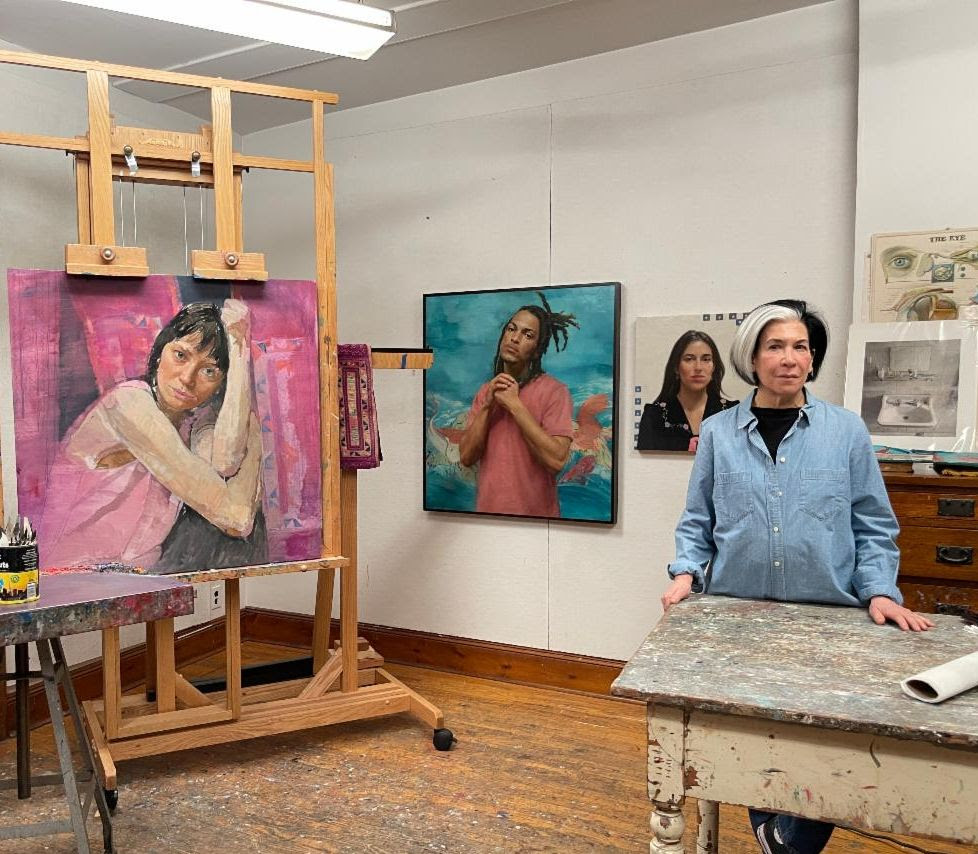
Sheinelle Jones, co-host of the 3rd Hour of Today on NBC, interviewed Sharon Sprung in her studio as part of the show's coverage of Women's History Month. The interview, which took place earlier this month, will be available for viewing on Today's website. Additionally, the interview will likely be broadcast this morning, Friday, March 24th, between 9 am and 9:45 am. Stay tuned.

As part of this exciting news, we have included images of Sharon Sprung's studio for your enjoyment. You can get a glimpse of where the interview with Sheinelle Jones took place and gain insight into the artist's creative process. We hope you find these images as inspiring as we do. Congratulations to Sharon Sprung.

Do not hesitate to contact the gallery to learn more about Sharon Sprung, her paintings, or her portrait commissions: Info@galleryhenoch.com, 917.305.0003

Sharon Sprung
RESTING BUT COMPLICATED, 2021
Oil on Panel
30 x 36 in (76.2 x 91.4 cm)
To stay up to date on Gallery Henoch and our artists, follow us on social media: @galleryhenoch on Instagram, Facebook, LinkedIn, and Twitter.
Gallery Henoch | 555 West 25th Street, New York, NY 10001

Thursday


Image description: A side full-body profile of Chella, who is nude and floats against a black background.
Tomorrow, Leslie-Lohman Board member Chella Man’s newest film, The Device That Turned Me Into A Cyborg Was Born The Same Year I Was premiers at the Leslie-Lohman Museum of Art. The film explores the nuances of life on a continuum between the Deaf and hearing world, oscillating between a daydream and nightmare as Man steps into his autonomy as a Deaf adult. 

“At its core, [this film] is an anthem on self-love and exploration, paralleling many lessons intimacy has granted me.” -Chella Man, writer, director, actor, artist

We’re excited to be the NYC home of this international premiere. The film will also premiere in Sydney, Australia at the Powerhouse Museum and in London with Nowness. The screening of this film will be followed by a moderated conversation including artist, sex worker and organizer Sammy Kim, Deaf surfer, skater, and snowboarder Darrick De La O, director, writer and producer Tony Zosherafatain, and director of photography Leroy Farrell. 

The film includes captioning. ASL and CART will be provided for this in-person gathering.

This event is at capacity and seating is limited. At the start of the gathering if there is space available tickets will be released to the waitlist on a first come first serve basis. We will do our best to accommodate as many waitlisted people who show up as possible.
Morgan Gwenwald in Conversation with Ariel Goldberg
hosted by the Magnum Foundation
Image Description: Morgan Gwenwald, Working on the "Keepin' On" exhibition [l-r: Paula Grant, Jewelle Gomez, Georgia Brooks]”, 1991, archival ink-jet print, 16x20.” Photo Courtesy the Artist
Morgan Gwenwald is one of a small group of out lesbian photographers who emerged during the early days of the gay rights movement. Her work has filled newsletters, journals and magazines from the 70s through the 90s, including: Nothing but the Girl: The Blatant Lesbian Image: A Portfolio and Exploration of Lesbian Erotic Photography, The Persistent Desire: A Femme Butch Reader, Sinister Wisdom, and On Our Backs, to name a few. Her goal has been to capture the world in which she lives in honest and loving detail. Her move to New York in 1979 started a long-term relationship with the Lesbian Herstory Archives where she still serves as a coordinator. 

In the first of two conversations between Goldberg, curator of Images on which to build, 1970s-1990s, and a photographer featured in the exhibition, Goldberg will speak with Gwenwald about her wide-ranging documentation of lesbian and queer grassroots organizing in New York City in the 1970s-1990s. A volunteer and coordinator at the Lesbian Herstory Archives (LHA) since 1979, Gwenwald will share rarely before seen materials, including documentation of the 1982 Barnard Sex Conference and portraits of influential and beloved community members. Join us and learn about Gwenwald’s practice, which includes publishing, exhibition making, constructing darkrooms, and building analogue networks for lesbian photographers to share skills and resources. 

This hybrid, in-person and remote conversation is co-hosted by Leslie-Lohman and the Magnum Foundation and takes place at Magnum Foundation, 59 East 4th St, 7W, on March 30th from 6:00-8:00pm. The in-person event is full, but there are still remaining RSVPs for the virtual component of the gathering. 

CART will be provided for the in-person portion of this gathering and captions provided for those joining online.
Celebrating Trans Day of Visibility with BTFA
Image description: A group of Black trans femmes holds hands on stage, preparing to bow. They wear schoolgirl outfits and are joyful. 
Leslie-Lohman Museum of Art is proud to partner with BTFA Collective for Trans Day of Visibility with a window installation that will activate the facade of the museum from March 31 through April 23. The installation will highlight work by visual artists Lexi Webster and Gatekeeper Adrian in the collective. By activating the city’s cultural hubs to spotlight this underserved community, Black Trans Femmes in the Arts hopes to bring in new audiences to support Black trans femme artists and their work. 

BTFA creates spaces for the production and preservation of Black trans art and culture by building community with Black trans femme artists and providing them with the resources and support necessary to thrive.

To support BTFA, visit btfacollective.org and follow them on social media at @btfacollective and come check out the window at Leslie-Lohman!
Audio Guide: I Love You Like Mirrors Do
Image description: Image Description: Coyote Park lies on their side, their head facing upward, their head resting between River’s legs. River, sits half-reclined in the opposite direction, their hand entwined with Coyote’s on Coyote’s tattooed chest. Both their eyes are closed. A draped piece of beige fabric fills the background, and the left and right sides of the image have botanical arrangements of greenery with red-orange flowers.
The audio accompaniment to Coyote Park’s I Love You Like Mirrors Do is now live. Download the Gesso app to hear our audio guide to Coyote Park’s I Love You Like Mirrors Do. The descriptions in this guide were written by artist and educator Paula Stuttman with voice work by Leslie-Lohman’s Visitor Experience manager and accomplished actor, Nicola Gorham. Additional thanks to Coyote Park. Courtesy of the Leslie-Lohman Museum of Art.
The Leslie-Lohman Museum of Art (LLMA) is the only art museum in the world dedicated to artistic exploration through multi-faceted queer perspectives. With a collection that includes over 25,000 objects spanning three centuries of queer art, LLMA embraces the power of the arts to inspire, explore, and foster understanding of the rich diversity of LGBTQIA+ experiences.
 
The Museum is generously supported, in part, by public funds from the Mellon Foundation, the Ford Foundation, New York State Council on the Arts with the support of the Office of the Governor and the New York State Legislature, and New York City Department of Cultural Affairs in partnership with the New York City Council. Programmatic support is also provided by the Achilles Family Fund, Booth Ferris Foundation, Rockefeller Brothers Fund, John Burton Harter Foundation, and the Foundation for Advancement in Conservation. Individual support is proudly provided by the Leslie-Lohman Museum of Art’s Board of Trustees and Global Ambassadors.
Facebook ‌ Twitter ‌ Instagram ‌
The Leslie-Lohman Museum of Art is open Wednesday 12-5pm and Thursday - Sunday, 12-6 pm.
Leslie-Lohman Museum of Art | 26 Wooster Street, New York, NY 10013