Monday

Support CA youth voices with SB 748! Learn how inside.
Is this email not displaying correctly?
View it in your browser.
APRIL 15, 2019

Friend on Facebook    Follow on Twitter    Follow on Twitter    Forward to Friend   

CAC seeks partner in fellowship for arts leaders of color

The California Arts Council is now accepting applications for a partner organization to develop and administer a new statewide pilot fellowship program for emerging arts leaders of color. The program is aimed at strengthening the field of arts and culture in California by uplifting an inclusive workforce and supporting the vibrancy of organizations that create and preserve the cultural identities of all California communities. More details are available in our press release.

It's not too late! Support arts ed on your CA tax return

Today's the day! Last-minute tax filers, don't forget to show your support for arts education with a tax-deductible donation of $1 or more to the Keep Arts in Schools Fund, found in the Voluntary Contribution Section of your state return. Learn more at keepartsinschoolsfund.org.

Arts Plate marketing consultant wanted

The California Arts Council is seeking a qualified full-service marketing agency or consultant to develop and execute a marketing campaign for the California Arts License Plate. The selected contractor will provide comprehensive marketing services in order to build awareness and increase sales of the California Arts Plate, including branding positioning, messaging, graphic design, marketing and media planning, digital strategy, advertising and website management. Proposals are due May 14 at 5 p.m. Details and how to submit can be found here.

Funding for prison arts program development - apply by 4/22

Is your organization interested in getting involved with our Arts in Corrections program, but you aren't fully there yet? This opportunity is for you! Up to $25,000 is available in support for innovative projects, training, and mentorship opportunities intended to break down the barriers of prison arts programming and work in state correctional settings. Funding is available both to current Arts in Corrections Coordinating Organizations and organizations interested in providing arts programming through the California Arts Council's Arts in Corrections program in the future. The deadline for proposals is April 22. Learn more here.

what's new
jobs
Grants Writer 
Center Theatre Group
Los Angeles, CA
Project Manager
Minnesota Street Project Art Services
San Francisco, CA
Program Coordinator
Vivace Youth Chorus of San Jose
San Jose, CA
Front of House Manager
American Conservatory Theater
San Francisco, CA
Individual Giving Manager
Oakland Museum of California
Oakland, CA
grants
artist calls
Art Works: Second Deadline
National Endowment for the Arts
Deadline: 2019-07-11
California Arts Leaders Investments Accelerator Program 
Center for Cultural Innovation
Deadline: 2019-12-31
May the Fourth be With You
Art Escape
Sonoma, CA
Make Your Mark
Art Attack SF
San Francisco, CA
Foundwork Artist Prize
Foundwork
Brooklyn, NY
The Other Art Fair Los Angeles
The Other Art Fair
Los Angeles, CA
Sense of Place
Art Works Downtown
San Rafael, CA
conferences/workshops
research
2019 Native American Museum Studies Institute
Joseph A. Myers Center for Research on Native American Issues
Berkeley, CA
Date: 2019-06-17

Audio Revery Cub, lithograph crayon on archival sketchbook paper, 9x12 inches by Kenney Mencher

Saturday

One of our furnished sunny studio spaces, shared or private

Morocco Artist Residencies | Green Olive Arts

Green Olive Arts is an international art studio and urban art residency in Tetouan, Morocco, specializing in connecting the creatives of the world with the culture, beauty and creatives of Morocco.
Our mission is to resource creative individuals of both emerging and established artistic talent from around the world in seasons of inspiration, production, collaboration and cultural exchange here in Morocco.
We invite artists from a wide range of disciplines and mediums to apply for residencies of 2-8 weeks for specific seasons throughout the year. We accept visual artists, writers, filmmakers, poets, curators, scientists, choreographers, puppeteers, and more. Our local Selection Panel awards residencies based upon artistic excellence of current work and intended residency proposal. Artists are encouraged, but not required, to engage the local community as part of their residency through workshops, mural projects, performances, readings, round tables, and other collaborations to bridge cultures and nurture creativity.
Green Olive Arts provides a space for artists to travel away from normal settings to do research and produce new works in a context offering an abundance of fresh inspiration and engagement with local creatives. GOA offers fully equipped production spaces, and opportunities for interaction and collaboration with other artists.
In addition to providing production space for groups and individuals, GOA offers resident artists a wide array of concierge services including arranging housing, custom designed and artisan focused tours, gallery connections, and personal connections with Moroccan artists.
Green Olive Arts was started by artists for artists as the culmination of the vision of American artists Jeff McRobbie and Rachel Pearsey. Having spent several years each creating art in Morocco, a shared dream began to emerge of how they could create a collaborative art space, where foreign and local artists could experience the richness of creating art alongside each other in a multicultural environment.
We are currently taking applications for the following residency periods:
  • WINTER – January 14 – February 23, 2019 – 2-6 week resourced, self-directed residencies - Apply
  • SPRING – March 21 – April 17, 2019 – UPROOTED: Convergence 2019 – A one-month curated group residency for up to 8 global artists in Tetouan, Morocco. Application Deadline, September 14, 2018.
  • SUMMER –June 17 – July 21, 2019 – 2-5 week resourced, self-directed residencies - Apply
  • FALL – September 23 – October 27, 2019 – 2-5 week resourced, self-directed residencies - Apply
Visit greenolivearts.com for more info...
Location

Tetouan: Morocco
Tetouan, Morocco is a jewel of a city, clearly off the well worn paths of Moroccan tourism and commerce. Situated in the North of Morocco, on the North-Western tip of Africa, Tetouan sits by the Mediterranean Sea in a beautiful valley at the intersection of two rugged mountain ranges. Tetouan's ancient walled city is a UNESCO World Heritage Site with a rich history and culture hidden within stuccoed walls. Here you will find Morocco’s prestigious National Institute of Fine Art, the starting point of many Moroccan artists, the National School of Architecture, the Royal Artisan School for children and Morocco's new Museum of Modern Art. Tetouan's architecture and second language reveal its place in history as the capital of the Spanish protectorate, a heritage that remains visible at every turn. With its annual International Festival of the Lute, countless fine arts festivals and associations, Tetouan has art “in its blood” on a grassroots level that is rarely seen in this part of the world. Green Olive Arts is located in the heart of this city, a few blocks from the king's palace, numerous transportation arteries, museums, galleries and the gates of the medina itself in the 10-room home of a prominent Tetouani family. Three large sunny studio spaces, a wood shop, supplies area, kitchen, laundry and 32 meter square exhibition space and an array of easels and other furniture accommodate artists' needs.

Statistics

  • Residency Length: 2 week to 2 months
  • Average number of artists in residence at a time: 5-6
  • Number of artists accepted in most recent year: 41

Eligibility

  • Application type: Open application
  • Collaboration: Must apply and be accepted individually
  • Geography: Open to US artists, Open to non-US artists
  • Additional eligibility information: 
    Green Olive Arts is open to emerging artists, mid-career artists and established artists. We welcome individuals and groups to apply and to come with their own plan for their residency time with us, although we do encourage collaboration and interaction among our resident artists.
  • Application deadline: March 01, May 01, July 01, September 01, November 01, January 01, March 01, May 01, July 01, September 01, November 01, January 01
  • Application Ongoing: Yes
  • Additional deadline info:
    8 studio spaces are available. Applications will be assessed and Residencies awarded by our local Selection Panel according to caliber of the artist's work and fit of the artist's residency proposal with the goals and capacity of Green Olive Arts. Approved applicants may expect a phone interview request before a final decision. Convergence 2018 Residency Deadline has been extended to December 31, 2018. More deatails on the Convergence 2018 curated group residency available here: http://greenolivearts.com/art-residency/convergence-residencies/convergence-2018-texture-time/

Past Residents & Quotes

Past residents: 
2018: Julia Olson – painting/drawing/portraits (USA), Candice Salyers – choreography/performance (USA), Noah Pollack – drawing/printmaking (USA), Elizabeth Sher – drawing/painting/video (USA), Sharon Moodie – installation art (Canada), Mohamed Haiti – comic art & illustration (Morocco), Inaam Obtel – instalation art (Morocco), Anne Louise Blicher Winther – printmaking/painting (Denmark), Salma Arastu – calligraphy/painting (USA/India), Robin Przybysz – textile sculpture (USA), Mia Villanueva – research/screenwriting (Philippines/USA), Natalie Moffitt – painting (USA), Rachel Maxi – painting/design (USA), Diane Arenberg – painting/printmaking/jewelry (USA), Isaac Wardell – music producing/composition (USA), Jackie Tileston – painting/drawing/collage (USA), Alizia Gonzales – painting/group collaboration (USA), Gueryung Lee – painting/silkscreen printmaking (USA), Charity Kittler – textile design (USA), Richard Sears – piano/music composition (USA), Elizabeth Kwant – video/photography & movement (UK), Kevin Todd – generative art/geometry (Ireland), Nidaa Aboulhosn – photography/writing (USA/Lebanon), Nicholas Angelo – mixed media painting/photography (USA), Sara Inacio – printmaking & social engagement (Brazil / USA), Cathy Weiss – mixed media/printmaking/painting (USA), Mirjam Elburn – textiles/installation (Germany), Sarah Peck – documentary film/drawing (USA), Sarah Pierce – novel writing (USA), Lisa Hesselgrave – painting/drawing/collage (USA), Mark Hesselgrave – architecture/drawing (USA), Vibhavari Jani – multi-disciplinary design (USA/India), 2017: Marion Claire Wasserman (USA), Claire Anna Watson (Australia), Heather Danso (USA), Sapentia Park (South Korea), Mark Lesser (USA), Nicci Pratten (Australia), Rabia Farooqui (Pakistan), Tamadher AlFahal (Kingdom of Bahrain), Hafdis Helgadottir (Iceland), Florence Husen (Netherlands), Niccy Pallant (Australia), Marthe Vary (Canada), Kira Winther (Denmark), Peter Mallen (USA), Florence Poirier-Nkpa (France/St. Martin), Carolyn Watson Dubisch (USA), Dan Callis (USA), Hajar Daide (Morocco), Michaela Savell (USA), Johann Nortje (New Zealand), Anne Foresman (USA), Monica Martinez (Mexico), Zhihao Guo (China), Anass Yahyaoui (Morocco), Lisa Matthiessen (USA). 2016: Maartje Jaquet – drawing (Netherlands), Nancy Walter – printmaking (Canada/USA) Gerry Craig – mixed media (USA) Britt Smelvær – printmaking (Norway/Denmark) Maria Velasco – installation art (Spain/USA) Rana Jarbou – filmmaker (Saudi Arabia) Alinah Akbar – drawing/miniature painting (Pakistan) Juliana Coles – visual journaling (USA) Taeesha Muhammad – sculpture/collage (USA) Kian Blethyn – painting/poetry (Australia) Barry Walkiewicz – watercolor/drawing (Canada), Gretchen McCullough – writer/novelist (USA/Egypt), Bart Rawlinson – writer/novelist (USA), Annie Raab – writer (USA), Tony Ingrisano – acrylic ink drawing (USA), Laura Cloud – sculpture/drawing (USA), Dale Roberts – oil/encaustic (USA), Lisa Waldron – photography/choreography (UK), Linda Ruth Paskell – photography/painting (USA), Elizabeth Hardy – sculpture/installation art (USA), Haya Alghanim – film/video/photography/new media (USA/Kuwait), 2015 Carrie Mixon – painter/fibers artist (USA), Yvonne Yuen Man Lo – digital photography collage (Hong Kong), Jane Zweibel – mixed media (USA), Erin Bolte – painter/fibers artist (USA), Hannah Leighton – painter (USA), Madiha Sebbani – Painter/video artist (Morocco), Sarah Gibson – painter (Australia), Digby Duncan – photographer (Australia), Eman Salah – graphic & street artist (Egypt), Jeff Olson – painter (USA), 2014: Fiona Leonard – writer (Australia/Ghana), Norio and Chifumi Ishiwata – mixed media artists (Japan), WeArt – a group of 5 artists of various mediums (Morocco), Sam Paonessa – plein air painter (Canada), Zora Buchanan – painter (Canada), Sook Chang – painter (Korea/Canada), Ashley Widman – mixed media artist (UK/USA), Frances Valesco – painter (USA), 2013 Janet Pelling – painter (UK), Elaine Muller – photographer/printmaker (USA), Carleigh Boyd – artist/art educator (USA), Yahya Frederickson – poet/writer (USA)
"I felt very inspired in Morocco. I loved walking through the old city of Tetouan... drinking in the atmosphere of the places and the smells. The sensory impressions were so unique, I couldn't get enough of that. Tetouan is such a 'real' city... unlike some other cities that seem to be more tourism focused. The sensory details of this place will overwhelm you and 'swamp your boat', in a good way. [Green Olive Arts] worked hard to make connections for me, to point me in directions, and introduce me to people. The arrangements were wonderful, and the opportunity to travel that they arranged for us really enriched our time there. Green Olive Arts offers something special."
— Yahya Fredrickson

Facilities & Services

  • Housing:
    We are happy to arrange your housing from among a wide range of options to suit your unique preferences and goals, and we've secured discount prices for residents of Green Olive Arts. Almost all of the housing options are within a short walk of the studios, near the center of Tetouan. You can choose from: an apartment attached to the studios, a private apartment, a home-stay with a Moroccan family, a Moroccan Riad (4 star B&B), 3 star hotel, or a 2 star hotel.
  • Meals: No meals/food provided
    Most of our housing options offer bed and breakfast or have an attached restaurant, but the studio facility itself has a kitchen so that residents may prepare their own food if necessary at the studios. On Fridays we offer a shared meal of traditional couscous for anyone working in the studios.
  • Computer/internet access: Computer and internet connection provided in common area (shared), Wireless Internet
  • Companions: Spouses/partners allowed for full stay, Children allowed for full stay
  • Accessibility: no
    The studio is located on the second floor, with stair access only. The city has a few steep hills and the streets and sidewalks are sometimes uneven or broken. It can be a challenge to get around if you have a physical disability that makes walking difficult.
  • Studios/special equipment: Exhibition / Installation, Fiber arts, Painting, Printmaking
  • Additional studio information: 
     Artists who have specific facilities’ needs should contact Green Olive Arts to determine if our studios will accommodate their work.

Residency Fees

Shared Studio, 1 -2 weeks - 2500 MAD ($250) per wk / Private Studio, 1 -2 weeks - 3700 MAD ($370) per wk with reduced rates for longer residencies. These fees are for non-Moroccan artists. We offer a reduced fee for our Moroccan artists in residence since they are fluent in both language and culture here.

Stipends / other support

Artists willing to engage the broader Moroccan community in English may be eligible for special stipends and grants from the American Language Centers of Morocco, the US and other Embassies, and particular local associations and educational institutions.

Additional expectations / opportunities

Accepted artists are responsible for travel, studio fees and housing/board. These costs are typically covered by personal funds or grants available to artists seeking overseas residencies. We help our approved applicants work out the best combination of studio, tour, and housing options to suit their art residency goals, comfort, and budget. Reduced rates for residencies longer than 6 weeks Collaborative relationships with local artisans and artists can be arranged for skill exchange and production Opportunities for architects and city planners to network with local colleagues and the National School of Architecture can be arranged Painting and sketching outings can be arranged with experienced guides and artists

Contact Information


B.P. 10001 Sidi Al Mandri
Tetouan, Tetouan 93000
Morocco
Tel: (212) 674.35.89.42

Thursday

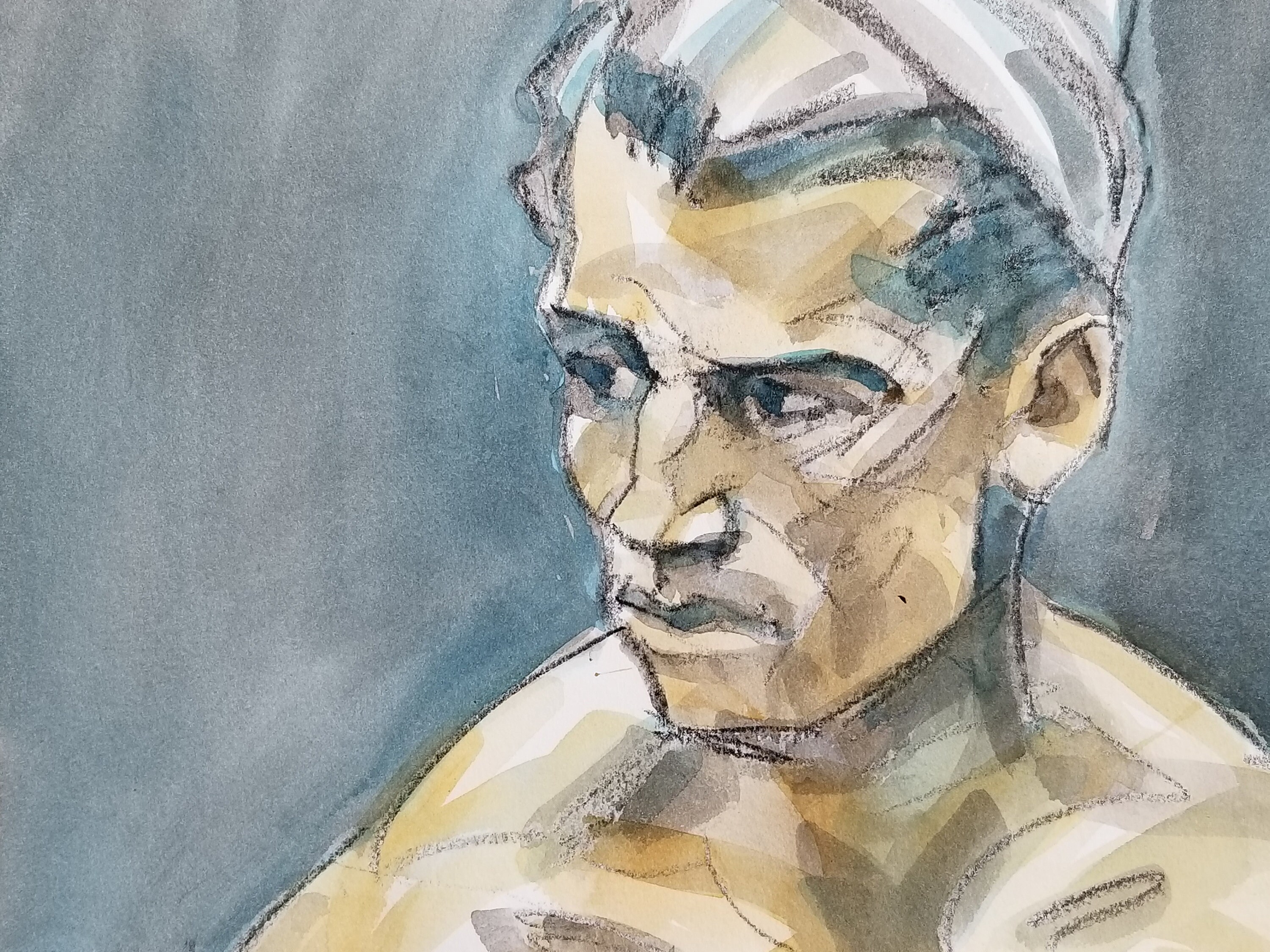
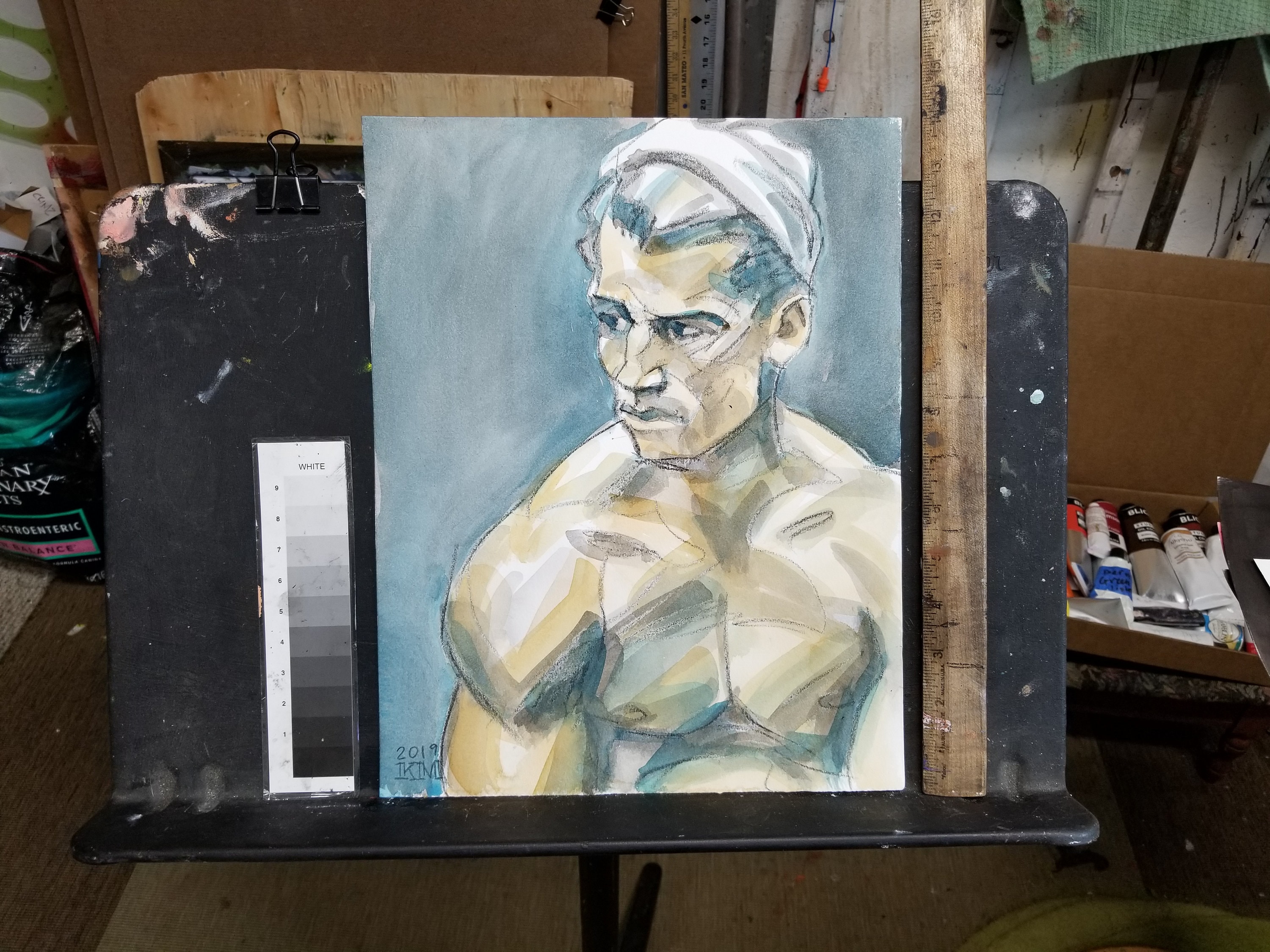
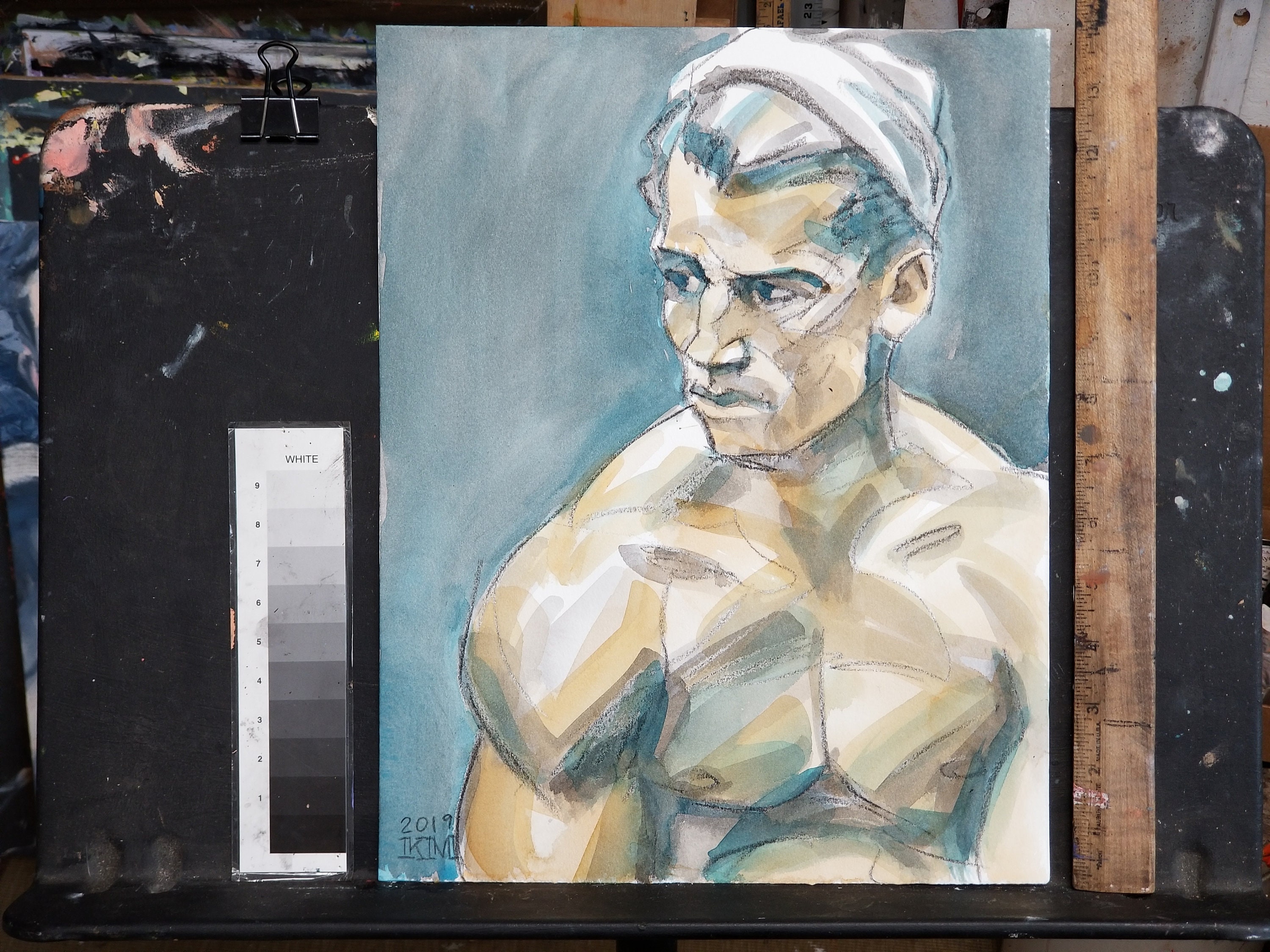
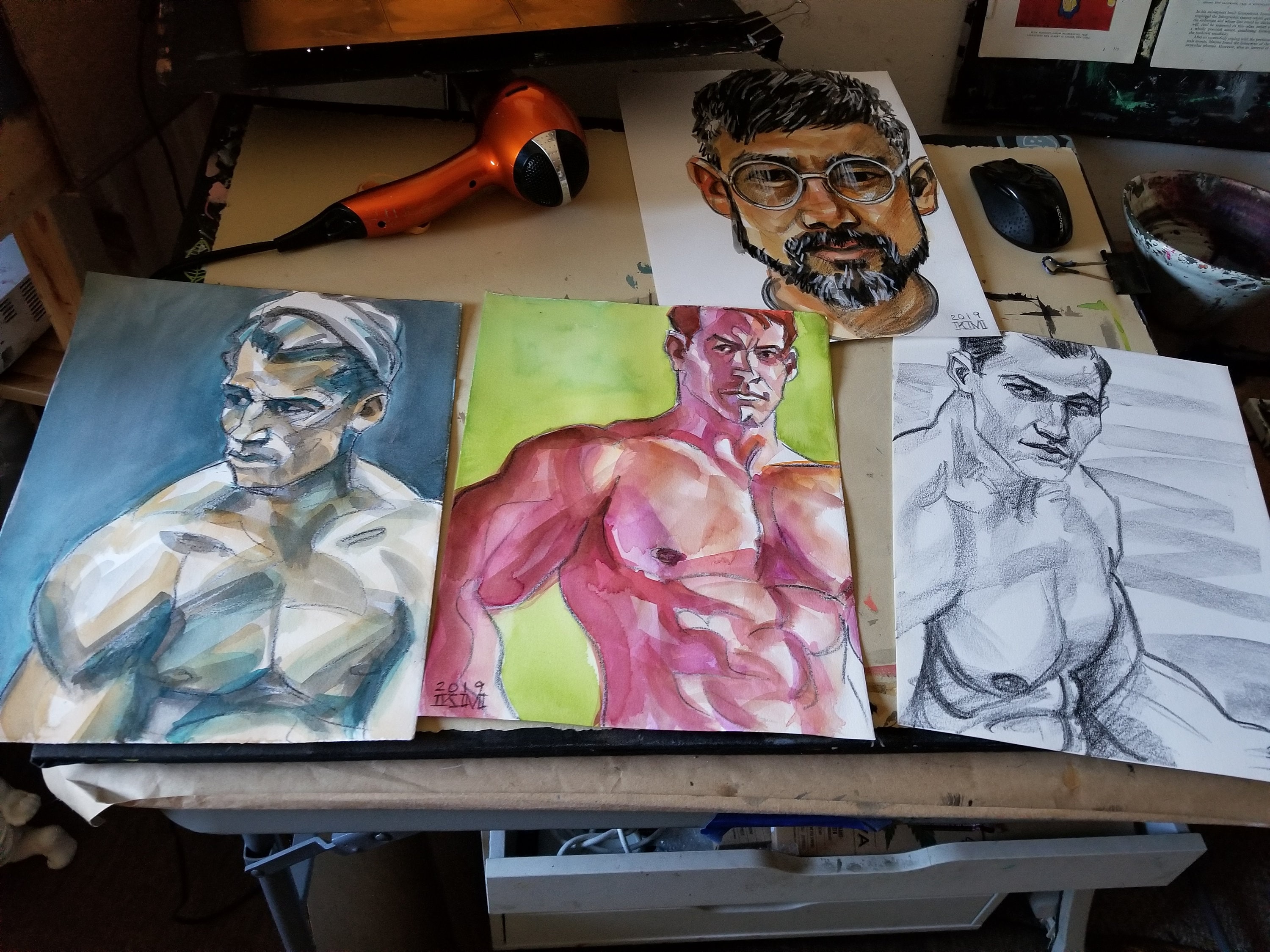
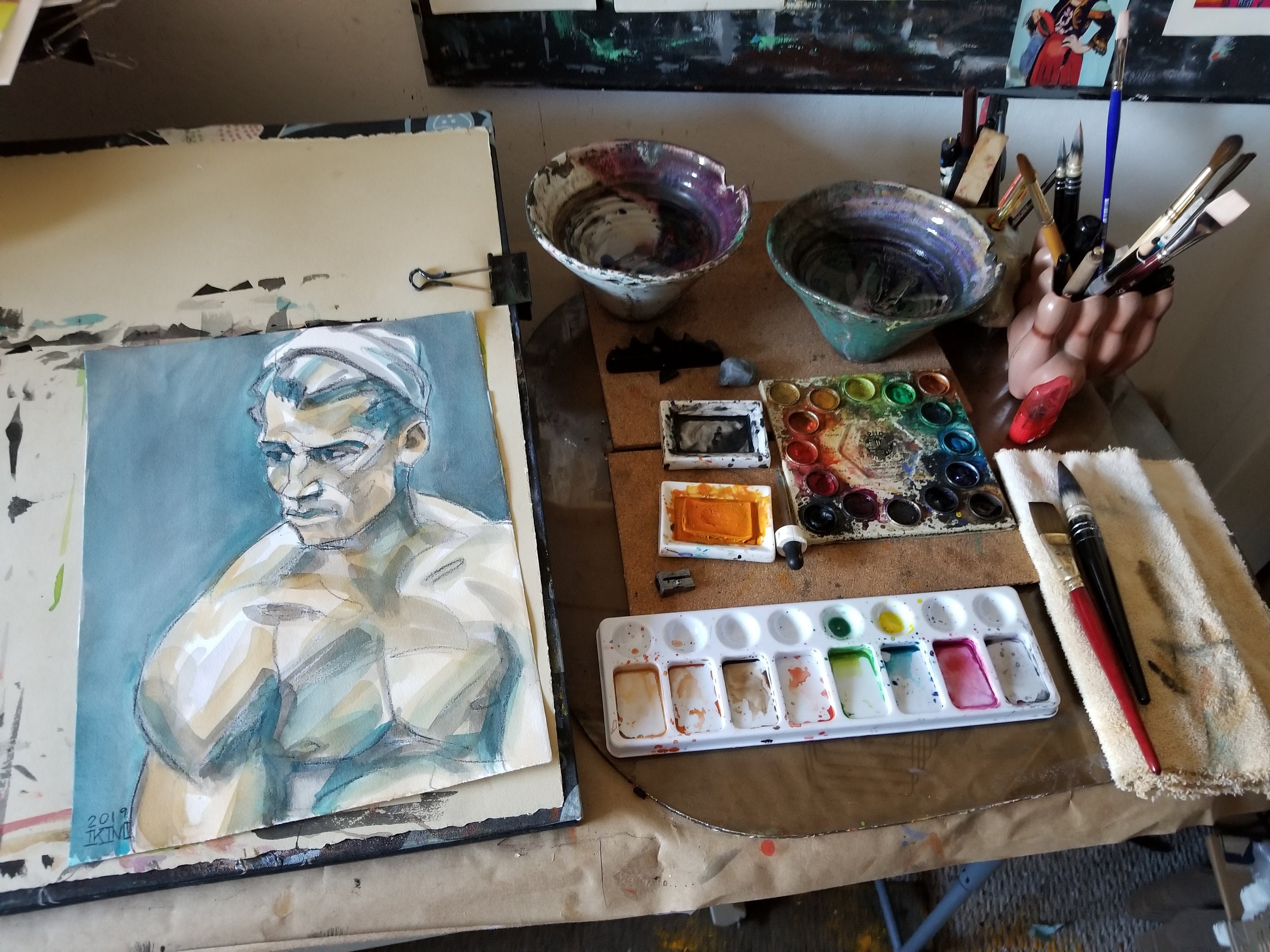
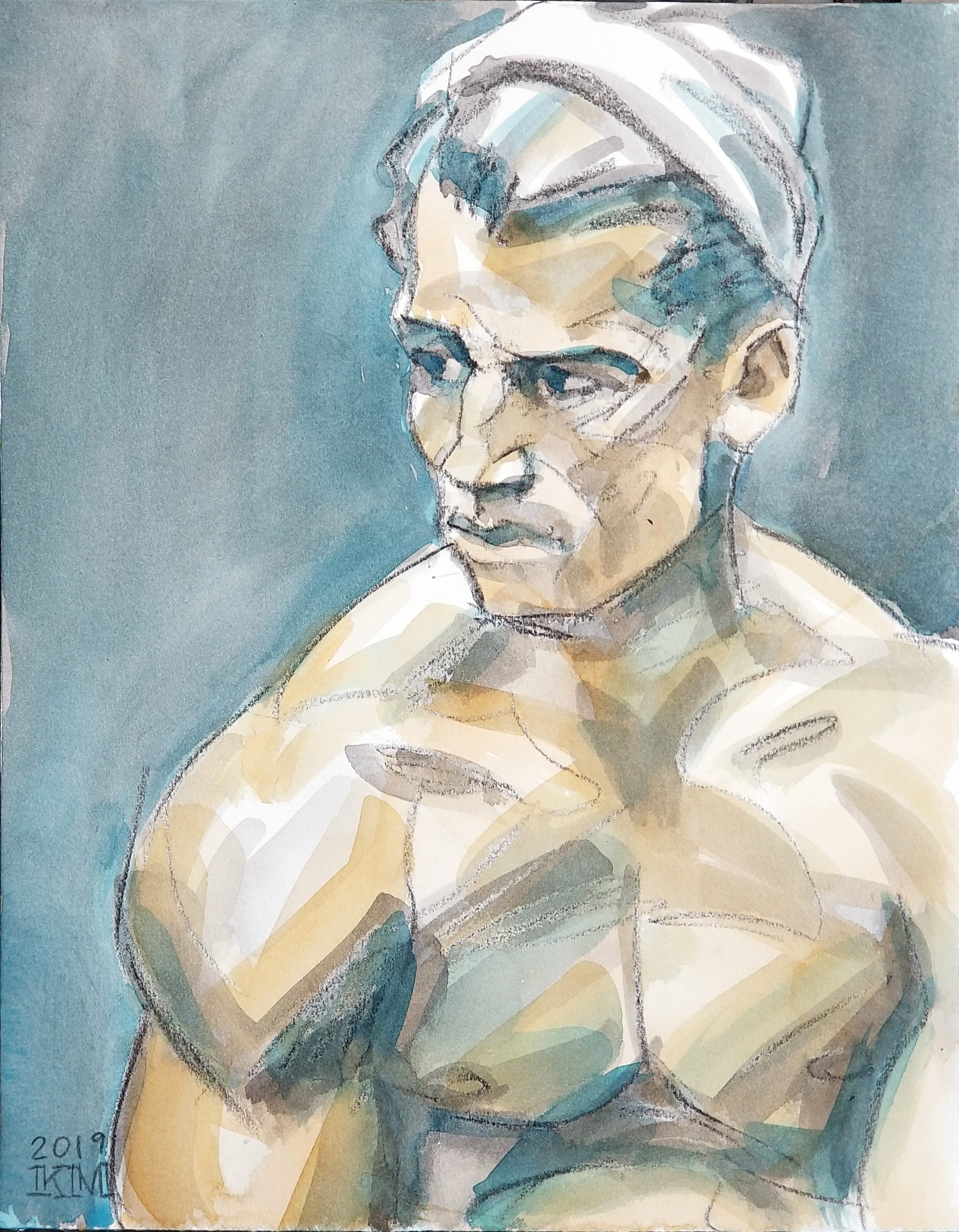
Beanie Baby Man, crayon and watercolor on Rives BFK paper, 11x14 inches by Kenney Mencher

Early Christian into the Byzantine, San Vitale


Church of San Vitale, Ravenna, Italy 526-47 CE
Byzantine Style


For all the videos in order with a textbook and study guides please visit:
https://www.udemy.com/user/kenneymencher/


Form: This central plan structure has an octagonal shape and two levels.  The arches walls and floors are all covered with ornate and intricate Byzantine style mosaic and tile work.  Arches and some vaulting are used and the center even has a dome, which from the exterior looks like an octagons full of windows that flood the interior with light. Eight large piers alternate with columned niches to define precisely the central space and to create a many layered design.  Nevertheless, the technology used to construct San Vitale is not quite as advanced as Hagia Sophia although the walls were lightened by the use of hollow pots in its interior.Iconography:  San Vitale reflects Byzantine influence and technological creativity. St. Vitale is the major Justinian monument in the West. It was probably built as a testament to the power of Orthodoxy in the declining kingdom of the Ostrogoths. He tries to establish a place where there are severe Christian Churches (people were forced to convert to Christianity).
Context:  On the second level of the ambulatory, is a special gallery reserved for women. This was a typical custom of Jewish religious worship. The reason for this, was to segregate the males from the females in order for them to pray with greater devotion.
For more details of  San Vitale go here.


Emperor Justinian and his Attendants
mosaic on north wall of the apse
Church of San Vitale, Ravenna, Italy 526-47 CE
Byzantine Style
Empress Theodora and Her Attendants.
mosaic on south wall of the apse
Church of San Vitale, Ravenna, Italy 526-47 CE
Byzantine Style
Form:  The interior of St. Vitale, is similar to the Pantheon and Hagia Sophia.  The design includes an enormous amount of different colored marble and all the other surfaces are decorated with mosaic or tile.  The ornamentation in the church's interior looks Islamic or Arabic although it predates Islam. The figures are stylized in a typical Byzantine mode.  The heads are too large and the bodies are covered completely with drapery that does not reveal the anatomy beneath.   It also shares some elements from the Arch of Constantine, the heads are big and there's no Contrapposto (liberal movement in figures).  The facial anatomy is stylized.  The face is also elongated and the nose meets the bridge of the brows and the eyebrows actually go directly into the nose.  These are some of the elements that become standardized in Byzantine Manuscript.
Stokstad discusses the reverse perspective of the image which basically is a denial of the illusionistic systems of Roman art that are apparent in the mosaics and frescoes of Pompeii.
Iconography:  Both the empress's and emperor's mosaics face one another across the apse and each holds one component of the eucharist.  Justinian holds the tray and the wafer which symbolizes the body of Christ.  In his twelve companions, which are roughly the equivalent to Jesus' twelve apostles, the emperor also has two symbols of the power he holds: on the earth he has his army to support him at his right hand.  Notice they have the implied mandate of the power of Constantine because of the chi ro on their shield.  (Here's what a chi ro is)
Chi-Rho n, pl Chi-Rhos [chi + rho] (1868): a Christian monogram and symbol formed from the first two letters X and P of the Greek word for Christ--called also Christogram What is Chi Ro? Chi Ro, pronounced (KI ROW), is probably the oldest monogram used for the name of Christ. It was found written along the walls of the catacombs, which were the cemeteries of the early Christians and also a place where they held their secret meetings. The Chi and Ro are the first two letters in the Greek word for Christ. Our CH was one letter in Greek and was shaped like our X. The Greek R had the shape of our P. By combining the RO or P to one arm of the Chi we get XP. As a pre- Christian symbol, the Chi Ro signified good fortune. The Chi Ro became an important Christian symbol when adopted by the Roman Emperor Constantine, representing the first two letters in the name Christ. According to Church Father Eusebius, on the eve of the Battle of Milvan Bridge, the Emperor saw the emblem in a dream, with the inscription "With this symbol, you shall conquer." According to the story, the battle was won. In return for the victory, Constantine erected Christian Churches. The symbol was the standard of the Emperor's army, prominently displayed on the Emperor's labarum, or battle standard. 
For his spiritual power he has the members of the clergy on his left.  Directly to his left is the archbishop Maximus whose face is almost as defined and unique as Justinian's. Theodora is surrounded by her ladies in waiting and the local clergy as well and Theodora holds the wine which symbolizes the blood of christ.  On her gown is an image of the three Magi carrying their gift to the newborn Jesus.  Both are wearing royal purple and both are placed at the center of the image.  The placement and the icons they carry and wear were meant to communicate to the viewer that the emperor and empress were the church and the only path to salvation.  This links theological and political power as a single theocratic unit.
Context:  (Stokstad gives a much more detailed discussion of the iconography in the Byzantine chapter.)
For more details of  San Vitale go here.


Capital, Church of San Vitale,
Ravenna, Italy 526-47 CE
Byzantine Style
For all the videos in order with a textbook and study guides please visit:
https://www.udemy.com/user/kenneymencher/
Form:  This capital at first appears to be an almost Tuscan or Doric capital but on closer inspection it is the correction of the original Greek and Roman orders.  Between the arch and the capital is an additional structure called an impost block.  The designs on the capital are much more ornate and less solid looking then its predecessors and combines carving, polychroming and mosaic.  The over all intricate organic patterning and weaving of the ornamentation is abstract and overly ornate. Iconography:  The organic vine like qualities refer to the symbol of Christianity as a vine that keeps spreading.   In the center of the column's capital and impost block are cruciform symbols.  Notice on the capital, the Greek cross formed of four circles that looks like the domed greek cross plan discussed on page 324 The Elements of Architecture, Multiple-Dome Church Plans.  The use of classical ornamentation and then the obvious changing of it is symbolic of the fusion of the Roman and Greek classic ideals wedded to the culture and decorative forms of the east as well as the iconography of Christianity.


Mosaic of Christ from the
Archepiscopal Palace in Ravenna
late 6th CenturyThis image of Christ from San Vitale demonstrates a shift
in Christian thought.  If you look at how Jesus is depicted
and how this passage relates to the Psalm at right you may
notice that Jesus is now a Christian soldier and defender.
This relates somewhat to the politics that govern the
interaction of Christianity with Islam in Byzantium almost
a century later.
PSALM 91,He who dwells in the shelter of the Most High
will rest in the shadow of the Almighty.
I will say of the Lord, "He is my refuge and my fortress,
my God, in whom I trust."
Surely he will save you from the fowler's snare
and from the deadly pestilence.
He will cover you with his feathers,
and under his wings you will find refuge;
his faithfulness will be your shield and rampart.
You will not fear the terror of night,
nor the arrow that flies by day,
nor the pestilence that stalks in the darkness
nor the plague that destroys at midday.
A thousand may fall at your side,
ten thousand at your right hand,
but it will not come near you.
You will only observe with your eyes
and see the punishment of the wicked.
If you make the Most High your dwelling --
even the Lord, who is my refuge --
then no harm will befall you,
no disaster will come near your tent.
For he will command his angels concerning you
to guard you in all your ways;
they will lift you up in their hands,
so that you will not strike your foot against a stone.
You will tread upon the lion and the cobra;
you will trample the great lion and the serpent.
(sometimes worded: 
You shall tread upon the asp and the viper, 
trample the lion and the dragon.)
"Because he loves me," says the Lord, "I will rescue him;
I will protect him, for he acknowledges my name.
He will call upon me, and I will answer him;
I will be with him in trouble,
I will deliver him and honor him.
With long life will I satisfy him
and show him my salvation."